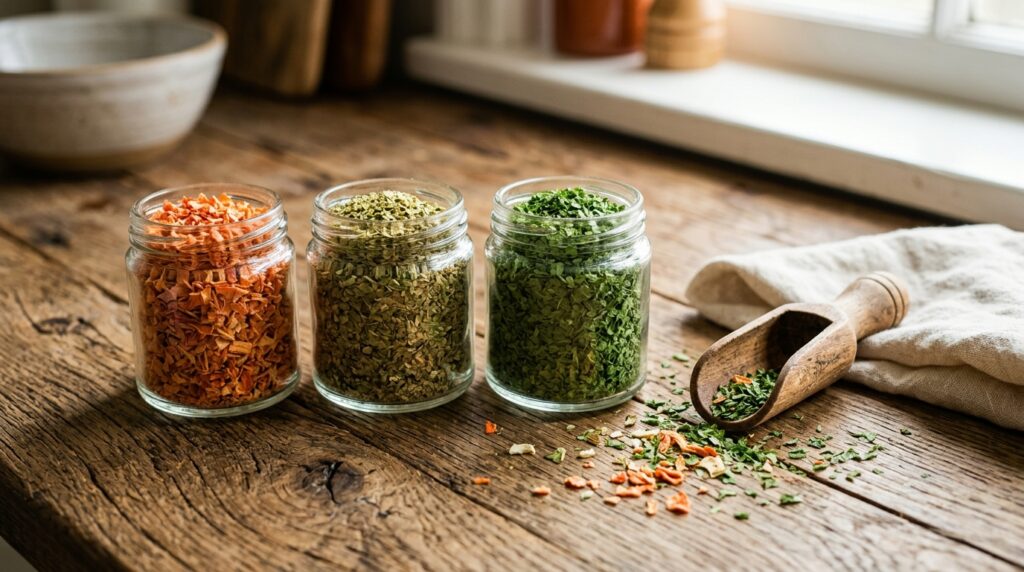
Once you start making your own bouillon powder and seasoning blends, you need a steady supply of dried vegetables and herbs. You can buy them, but drying your own is cheaper, uses up the veg that would otherwise wilt in the drawer, and means you know exactly what is in the jar. It is also weirdly satisfying. Here is how to build the habit.
What to dry. The workhorses for our kitchen are carrot, celery (stalks and leaves), leek, onion, tomato, and any herbs you use a lot, parsley, basil, oregano, thyme. Slice everything thin and even so it dries at the same rate. Tomatoes go in slices or halves, cut side up.
Three ways to do it.
The oven. Set it as low as it goes, ideally around 60 to 70 C / 140 to 160 F, prop the door open a crack with a wooden spoon to let moisture escape, and spread the veg on lined trays in a single layer. It takes a few hours depending on the vegetable. Done means brittle, not bendy.
The air-fryer. Many air-fryers have a low dehydrate setting, and even a low normal setting works for small batches. Watch it more closely than the oven, it moves faster.
A dehydrator. If you find yourself doing this often, a basic dehydrator is cheap, runs at the right low temperature without thinking about it, and frees up your oven. Worth it once the habit sticks.
Storing it. The golden rule is that everything must be completely brittle before it goes in a jar. Any moisture left behind will spoil the whole batch. Cool the dried veg fully, then store in clean, dry, airtight jars out of the light. Whole-dried pieces keep longer than powder, so dry in pieces and only grind what you need for the next jar of bouillon or seasoning.
Stepan’s Rule: Dry in pieces, grind in small batches. Whole dried vegetables keep for months, but the moment you grind them to powder the clock speeds up. Make powder as you go.
A food-safety note, since drying is a preservation method and worth doing right. Pieces must be brittle and snap, not leathery, because any trapped moisture invites mould. Store airtight, label with the date, and if you ever open a jar to a musty smell, a soft texture, or any spot of mould, throw the whole jar out without tasting it. When in doubt, bin it. The point of this habit is clean, safe flavour, not a gamble.
A phase note, because not everything here is a phase 1 food. Carrot, celery, tomato and the herbs are fine early. Onion and leek are phase 2 on my list, so if you are in the first weeks home, dry those and leave them in the jar until you have reintroduced them properly.
This is the supply line for the bouillon and seasoning recipes, and it turns the sad half-bag of carrots into something useful instead of compost.
Patient experience, not medical advice.
Drying veg and making your own staples is exactly the kind of practical, money-saving habit our community swaps tips on. Come share your setup and steal everyone else’s.