Not medical advice. I am a patient sharing what worked for me. Your team knows your case, so run any real plan past them, especially if you are on enzymes or managing blood sugar.
Nobody warns you how fast the weight comes off. Between the flare, the low-fat fear, the days you eat almost nothing because you are scared of the pain, and the malabsorption itself, the number on the scale can fall in a way that looks alarming. Then a well-meaning relative tells you to “just eat more,” and you want to laugh, because more is exactly the thing your pancreas has been punishing you for.
Here is the trap. The two easy ways to add calories, more fat and bigger meals, are the two things most likely to set off a pancreas that is still healing. So I had to gain weight the slow way.
What actually worked for me
I added calories through carbohydrate and lean protein, not fat. Rice, oats, potatoes, pasta, peeled fruit, low-fat dairy, chicken, white fish, egg whites. These are gentle and they add up.
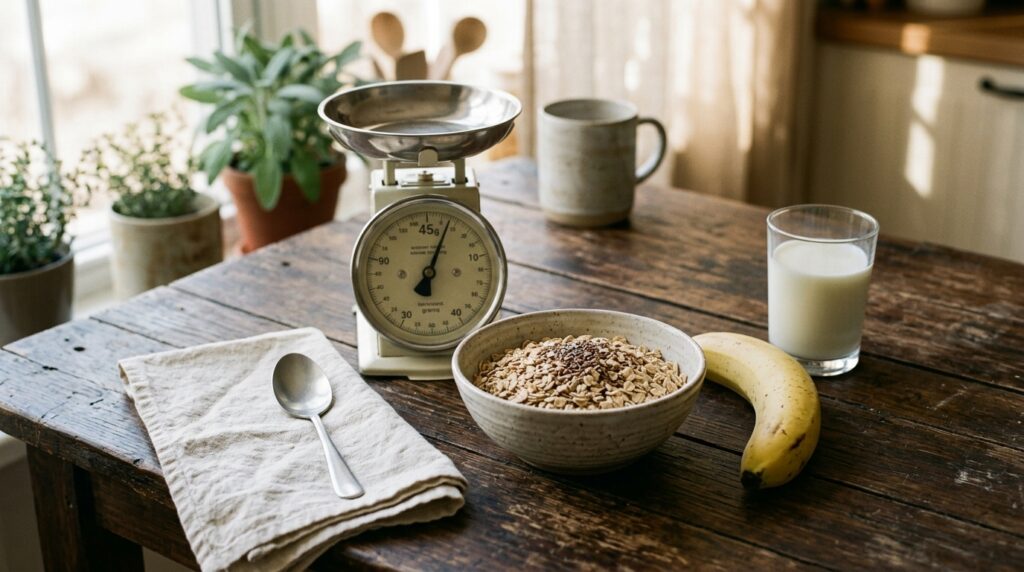
I ate more often instead of eating bigger. Five or six small meals a day put more total food through me than three large ones ever could, and small meals are far kinder to the pancreas. A snack was a bowl of oatmeal, a banana with a little honey, plain yogurt, or a piece of toast.
I made my calories count in liquid form when solids felt like too much. A blended oat and banana drink with low-fat milk goes down when a plate feels impossible.
And if you are on enzymes, this is where they earn their keep. Malabsorption means some of what you eat leaves without being absorbed. Getting the enzyme dose and timing right with your team can be the difference between eating well and still losing.
I did not rush it. Slow, steady regain is the goal. Fast weight gain usually means a lot of fat, and that is the road back to the hospital.
Stepan’s Rule: Add calories with carbs and lean protein, not fat, and eat more often rather than eating more at once. Small and frequent beats big and brave.
Nutrition drinks, and the one number to check
One more thing belongs in the cupboard: ready-made nutrition drinks, the kind dietitians call oral nutritional supplements. In the US that’s Ensure and Boost. In Europe it’s Nutricia’s Nutridrink, which the UK sells as Fortisip. One bottle gives you somewhere between 180 and 360 calories you can sip slowly, on the days when a plate of food feels like a negotiation.
In the US they sit on the supermarket shelf. In Europe they’re mostly a pharmacy product, and in the UK a GP or dietitian can prescribe them.
The catch is fat. The standard milky ones carry a lot of it:
- Ensure Plus: 350 kcal, 16 g protein, 11 g fat per 8 oz bottle
- Boost Plus: 360 kcal, 14 g protein, 14 g fat per 8 oz
- Nutridrink (Fortisip in the UK): 300 kcal, 12 g protein, 11.6 g fat per 200 ml
If your gentle-phase budget is 20 to 30 g of fat a day, one of those uses up roughly half of it. Drink two and the day’s fat is gone before dinner.
So look for the clear, juice-style versions. They have no fat at all:
- Ensure Clear: 180 kcal, 8 g protein, 0 g fat per 10 oz
- Boost Breeze: 250 kcal, 9 g protein, 0 g fat per 8 oz
- Nutridrink Juice Style (Fortijuce in the UK): 300 kcal, 8 g protein, 0 g fat per 200 ml
They’re sweet, though, because most of those calories are sugar. If anyone is keeping an eye on your blood sugar, ask before you make them a daily habit.
If protein is what you’re short on, Ensure Max Protein is the odd one out: 30 g protein, 2 g fat and 150 kcal in an 11 oz bottle, with barely any sugar. It’s low in calories, so it pairs best with the gym, which is the next bit.
For chronic pancreatitis, ESPEN’s 2024 nutrition guideline puts these drinks after ordinary food: they come in when your meals aren’t reaching your calorie and protein goals. Use them as a top-up between meals, and read the label every time you buy, because manufacturers change their formulas.
Put some of it back as muscle
Weeks in a hospital bed strip muscle off you, and muscle is heavy. Rebuilding it puts weight back on and makes you stronger at the same time. So once you’re properly recovered, the gym belongs in this plan.
Properly recovered is doing a lot of work in that sentence. The first month after hospital is walking and nothing more. After my second hospitalization, in November 2025, it was two to three months before I set foot in a gym. After the first one, it was almost two years.
When I went back, I went light: machines before free weights, small loads, and nothing that strained my core or my belly. Your pancreas tells you when it’s too much. For me that’s a dull awareness in the left side, or tiredness that hits harder than the workout deserves. When it shows up, I back off and try again the following week.
The rules I follow: if you can hold a conversation, you’re in the right zone. And treat pain in your left side or upper belly, during or after a session, as a warning sign. Stop, rest, and call your doctor if it hasn’t settled within an hour.
Get your team’s go-ahead before you start, especially after necrosis or surgery. Protein is what muscle is built from, which is where that Ensure Max Protein bottle comes in.
The full recovery playbook
Rebuilding, from flare days to stable eating, phase by phase, is the whole spine of the PancreasZen book, along with 75 tested recipes built around this exact problem. It is the plan I pieced together the hard way, in one place.
The book also has the full timeline of when each kind of movement came back for me: walking, salsa, swimming and the gym.