Not medical advice. I am a patient who went and read the guideline so you do not have to. The decisions are yours and your doctor’s.
In May, five gastroenterology societies from Spain, Portugal and the Americas published a new clinical guideline for acute pancreatitis. Twenty recommendations, each one graded by how strong the evidence behind it actually is. The short name is iLATAM-AP.
It is written for doctors and it reads like it. But nearly every line of it describes something that gets done to you, or deliberately not done to you, while you are lying in a hospital bed. So it is worth knowing what is in there.
A surgeon, Dr. Gunjan Desai, walked through the whole thing in 14 minutes on his channel Edusol Clinics. Start there if you want the clinical version.
What follows is the same material in plain language, checked line by line against the paper itself rather than against the video.
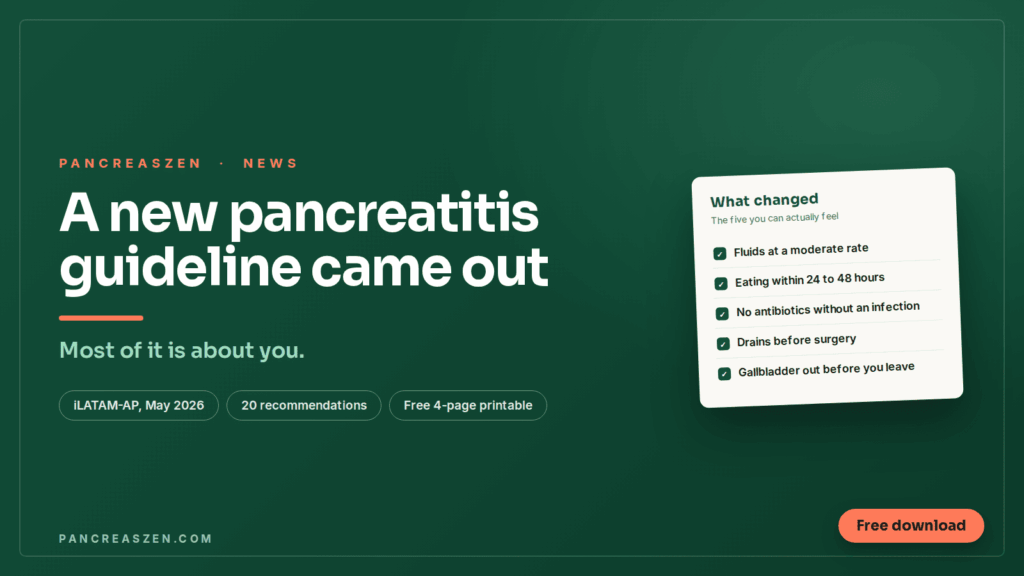
Fluids run slower now
The old reflex was litres of IV fluid, fast, through the first day. The guideline now asks for a moderate rate: about 1.5 ml per kilo of body weight per hour, using lactated Ringer’s rather than plain saline. For a 70 kg adult that works out at roughly 105 ml an hour.
A faster bolus, 10 ml per kilo over two hours, comes first, and only if you arrive genuinely dry. It can be repeated if you dry out again later. If you start to overload, the fluids get cut back or stopped. This one carries the guideline’s top rating: strong recommendation, high-quality evidence.
So if the drip looks more measured than you remember from a previous admission, that is current practice rather than under-treatment.
You eat sooner than you think
Keeping people nil by mouth as a matter of routine is finished. The guideline asks for oral feeding within 24 to 48 hours, for mild and predicted severe cases alike, and the test it uses is whether you feel able to eat. In mild cases you can start straight away on soft or solid food.
If you still cannot manage three to four days in, a feeding tube through the nose to the stomach is the preferred next step. A longer tube into the small bowel is kept for slow stomach emptying, a blockage higher up, or a high risk of food going into the lungs. Nutrition straight into a vein is the last resort.
Again, strong recommendation, high-quality evidence. Being starved for a week is a long way behind where the evidence sits.
Antibiotics need a reason
There is a strong recommendation against handing out antibiotics simply because there is necrosis on the scan. They are kept for suspected or confirmed infected necrosis, for infection of the bile ducts, and for infections elsewhere in the body. A blood marker called procalcitonin can be used to cut down on the courses you do not need. Antifungals follow the same logic.
Pain gets treated properly
The approach is multimodal, built on anti-inflammatories and opioids, chosen around your other conditions, how bad the pain is and how severe the attack is. For a mild attack, anti-inflammatories and paracetamol may be enough on their own, with opioids added if that does not hold it. For moderate to severe pain the options include anti-inflammatories by injection or drip, strong opioids alone or alongside them, or an epidural.
From there the guideline works downwards, easing the painkillers off as the pain settles.
Gallstones: the bit that decides your next year
An urgent ERCP, inside 24 hours, is for one situation only: pancreatitis together with cholangitis. If there is a stone in the bile duct but no cholangitis and you are stable, the guideline says the ERCP can wait. Plenty of stones pass on their own, and a rushed procedure can make the pancreatitis worse.
Then the one that matters most. After a mild gallstone attack, the gallbladder should come out during the same hospital stay. Going home with it still in is what brings people back. After a severe attack the surgery waits, usually around eight weeks after discharge.
Dead tissue: drains before knives
When part of the pancreas dies and the collection becomes infected, the order of moves is set. Where an intervention is needed at all, waiting at least four weeks is preferred, so the collection has time to wall itself off. Then a drain, placed through the skin or endoscopically through the stomach wall. Then endoscopic removal of the dead tissue if the drain is not enough. Minimally invasive surgery is for when those fail.
The part that gets dropped
This is the section I would put on the fridge.
After necrotizing pancreatitis, after a necrosectomy, after repeat attacks, or with alcohol as the cause, you are at risk of two long-term problems, and both are easy to miss.
The first is exocrine failure: the pancreas stops making enough digestive enzymes. The sign is pale, greasy, floating stools that are hard to flush, often with weight loss. The screening test is faecal elastase, done on a stool sample, and the treatment is enzyme replacement taken with food.
The second is endocrine failure: the insulin-producing cells are damaged and you develop diabetes, the type 3c kind. It is found with a fasting glucose, an HbA1c or a C-peptide. The guideline adds a second group here, anyone carrying obesity, high blood lipids or prediabetes beforehand.
Follow-up is advised at 3, 6 and 12 months, then every 6 to 12 months if something is still not right. The authors are honest that the evidence behind those intervals is weak. It is still more of a plan than most of us get handed on the way out of the door.
Nobody booked those appointments for me. Put the dates in your own calendar.
One thing the video gets wrong
Worth flagging, since I have linked it above. The video says anti-inflammatories are not used for pancreatitis pain. The paper says the opposite, in one of its strongest recommendations. Everything above follows the paper.
The four-page summary, free
I put all of this on four pages you can print and take with you. The first part is the guideline in plain language plus five questions worth asking on the ward. The rest is fillable: your follow-up dates, your own attack details for the next doctor who asks, the symptoms to watch for in between, and a page to write on.
Type your email and both PDFs open right here. A copy goes to your inbox too.
You also get my newsletter, one click to unsubscribe. Privacy
The source
Cárdenas-Jaén K, Guilabert L, et al. AEG-AESPANC-OPGE-SIED-SPG Ibero-Latin American Guidelines on Acute Pancreatitis (iLATAM-AP). United European Gastroenterology Journal, 30 May 2026. Open access: doi.org/10.1002/ueg2.70190
The five societies are the Spanish Association of Gastroenterology, the Spanish Association of Pancreatology, the Panamerican Gastroenterology Organization, the Interamerican Society of Gastrointestinal Endoscopy and the Portuguese Society of Gastroenterology. A patient representative from the National Pancreas Foundation sat on the panel through every stage, which is rarer than it should be.
One caveat worth keeping in mind. Guidelines are not law, and pancreatitis care genuinely differs between countries. Take this as a set of questions worth asking, and let your own team answer them.
If you want to talk the guideline through with other patients, bring your questions to the free PancreasZen community.