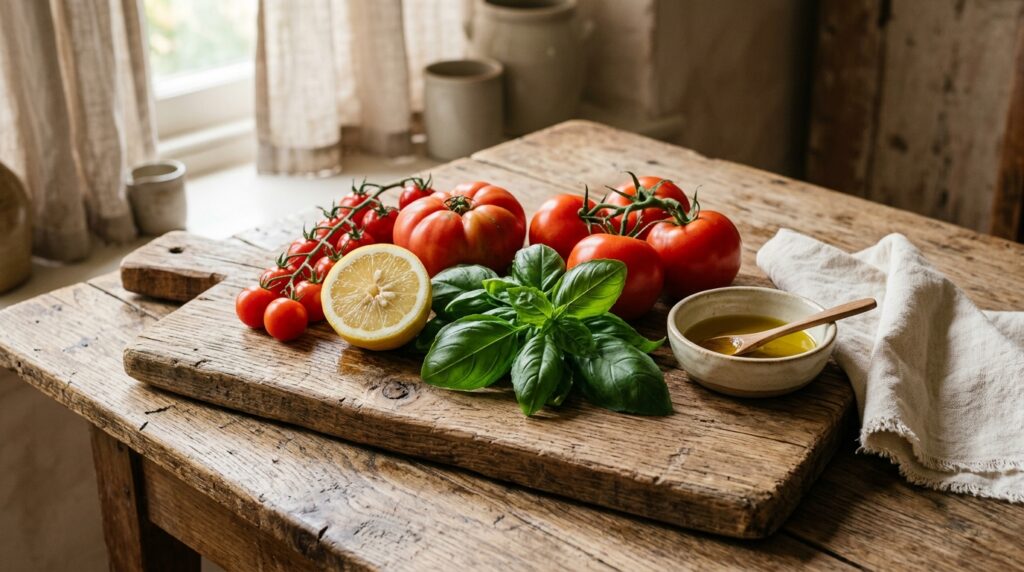
There is a study worth knowing about. A cohort that followed people over time found that those who ate most like the Mediterranean pattern had a lower risk of developing chronic pancreatitis than those who ate least like it. That is interesting on its own. The catch is that the classic Mediterranean diet is built on olive oil, nuts and oily fish, and if you are managing pancreatitis you cannot just pour olive oil over everything and call it healthy.
So the useful question is not “should I eat Mediterranean.” It is “which parts of it fit a low-fat pancreatitis plate, and which parts do I leave on the shelf.”
Take first, freely: the vegetables, the legumes, the herbs. This is where the Mediterranean pattern earns its reputation and where almost none of the fat lives. Tomatoes, courgette, fennel, leafy greens, beans, lentils, chickpeas. A bowl of well-seasoned vegetables and lentils is about as Mediterranean and as pancreas-friendly as food gets. Lean into it.
Take, but measure: the fish and the lean protein. White fish is naturally low fat and fits any phase. Oily fish like salmon and mackerel carries the omega-3s the Mediterranean diet is praised for, but it is genuinely high in fat, so it sits as an occasional, measured, stable-phase food, not a daily habit. Weigh the portion. Enjoy it. Do not pretend it is free.
Here is the nuance a dietitian would add, and it matters. A small, measured amount of unsaturated fat, a teaspoon of olive oil, is not the enemy. Olive oil is not poison. What harms a recovering pancreas is the total fat load across the day and big spikes in any single meal, not a careful teaspoon for flavour. Your own tolerance is individual, and it tends to widen as you move from the strict phase into the stable phase. So the rule is not “zero oil forever.” It is “small, measured, spread out, and tuned to your own tolerance.”
Two cautions worth holding. First, do not let “low fat” tip into undereating. People managing pancreatitis can quietly lose too much weight, and a diet so stripped back that you are not getting enough calories or protein is its own problem. The Mediterranean emphasis on legumes and fish is useful here precisely because it brings protein and substance, not just leaves. Second, if you have ongoing fat malabsorption, your team may suggest specific fats such as MCT (medium-chain triglyceride) oil, which is handled differently by the body. That is a conversation for your dietitian, not a swap to make blind.
Stepan’s Rule: Steal the vegetables, legumes and herbs whole. Borrow the fish by the gram. Keep the oil to a measured teaspoon, not a poured glug. That is Mediterranean on a fat budget.
The flavour worry is the one people raise, because they assume low fat means bland. It does not. The Mediterranean kitchen flavours food with garlic, lemon, herbs, tomato and a little acid, not just with fat. Those tools cost you almost nothing on the fat ledger and they are the reason the food tastes alive. That is the part worth copying most of all.
I have built my own plate around exactly this, vegetables and lean protein and herbs doing the heavy lifting, fat arriving in small measured amounts, and enough of it to actually stay nourished. The full framework, with the fat budget worked out in grams and the recipes that live inside it, is in the book.
Your own grams per meal come out of the fat budget calculator; plan the plate above into it and see how much oil is left.
Patient experience, not medical advice. A linked risk in a population study is an association, not a promise for any one person. Talk to a dietitian about your own fat target.