Leftover rice, cold potatoes and moldy bread: what’s true and what’s kitchen folklore
Cooking once and eating 3 times saves energy on a bad day. It also fills your fridge with leftovers, and leftovers come with a lot of folklore.
Next-day rice is poison. Never reheat spinach. Scrape the mold off the jam and carry on.
I went through what the food safety agencies and the studies say. Some of the folklore holds. Some of it is flat wrong. And 1 piece of it (the cold potato) is good news if you watch your blood sugar.
Why I take the stricter rule
Nobody has studied food poisoning in people with pancreatitis. I looked, and there’s nothing.
But 2 things many of us carry put us on the official “higher risk” lists.
Diabetes is on those lists in the US and the UK. And diabetes shows up in 26% to 80% of people with chronic pancreatitis, depending on which group you count.
Then there are acid blockers like omeprazole. Scotland’s food agency lists them as a reason to count yourself higher risk. A Dutch study of 14,926 people found about twice as many gut infections in people on them, and a pooled analysis of 9 studies found more. All of it is observational, so treat “about double” as a careful guess. Keep taking the medicine. Just be pickier about food.
My own reasoning, with no study behind it: a day of vomiting costs us more. You lose the enzymes, the meds and the food you fought to keep down, and it’s hard to tell from a flare.
So where the US and the UK give different numbers, I take the stricter one.
Before it goes in the pot: wash it
I wash my rice every time. 1 to 2 minutes under cold water, moving it around with my hand or a spoon, then drain.
You don’t know where that rice was stored or what it was shipped in. Washing takes off dust, bits of husk and the odd stone. It takes off some plastic too: in a University of Queensland test, washing removed 20% to 40% of the microplastics in rice.
In my pot, washed rice clumps less. I’ll be honest about that one: when researchers tested it on 3 kinds of rice, washing made no difference to stickiness. The variety decides how sticky rice gets. So that’s my kitchen talking, and the lab disagrees.
2 things washing won’t do for you. It rinses off some minerals along with the dust. And it does nothing for the leftover problem below: the spores survive cooking, so the 1 hour rule stays.
I do the same with bulgur and lentils. For lentils and dried beans the US extension services say it too: pick out stones and dirt, then rinse under cold running water.
Rice: the clock starts when it leaves the pot
Rice from yesterday is fine. Rice that sat on the stove all evening is the problem.
Raw rice can carry spores of a bacterium called Bacillus cereus. Cooking doesn’t kill the spores. If the cooked rice then sits warm, they wake up, multiply and make a toxin in the food.
That toxin (cereulide) survives 250 F (121 C). Frying, the oven and the microwave don’t touch it. So reheating kills the bacteria and leaves the poison. Rice that was left out too long can’t be rescued.
What you get is vomiting, 30 minutes to 6 hours after eating, or diarrhea 6 to 15 hours after. People call it fried rice syndrome. Pasta, noodles and potatoes do the same thing.
How bad? Usually a rough day. The CDC’s estimate for the US is about 63,400 cases a year, about 20 hospital stays and 0 deaths on average. Deaths happen, and they’re rare enough to end up in medical journals: in Brussels in 2008 a 20 year old died after eating spaghetti that carried a very high dose of the toxin.
The rule:
- Out of the pot, into a shallow container, into the fridge within 1 hour.
- UK agencies say eat it within 24 hours and reheat it once. The USDA’s general leftover rule is 3 to 4 days. I go with 1 day, or the freezer.
- Reheat until it steams all the way through, 165 F (74 C).
- Left out overnight: bin it.
The cold potato trick is real, and smaller than the internet says
When cooked starch cools, part of it re-forms into a tighter structure your small intestine can’t break down well. It’s called resistant starch, and it behaves more like fiber.
Part of it. In 1 study, rice went from 0.64 g of resistant starch per 100 g when fresh to 1.65 g after 24 hours in the fridge. Most of the starch stays ordinary starch.
Still, the blood sugar numbers move:
- Cooled and reheated rice, 15 healthy adults: about 18% lower blood sugar curve.
- Boiled potatoes eaten cold: glycemic index 56, against 89 hot.
- Potatoes kept cold for 24 hours, 13 people: 28% lower insulin response.
- Chilled potato, 30 women with raised fasting glucose: 5% to 9% lower blood sugar in the first 30 minutes, no difference over the whole curve.
Reheating doesn’t cancel it. The rice and pasta trials reheated the food and still saw the effect.
Every one of these trials is small (13 to 32 people) and covers 1 meal. Nobody has shown a long-term benefit from eating cooled starch. Diabetes UK and Diabetes Canada both say it may help a little, and that how much carbohydrate you eat matters more.
If you’re on insulin, read this part twice. In a trial of 32 people with type 1 diabetes, cooled rice with the usual insulin dose gave 12 hypos against 3. Many of us have type 3c diabetes, which is known for hypos, and nobody has tested cooled starch in type 3c or in pancreatitis at all. Check your sugar and talk to your diabetes team before you build a routine on this.
And the trick lives in the same pot as the rice problem. Fridge within 1 hour, eat it the next day.
Mold: soft food goes in the bin, hard food can be trimmed
What you see on the surface is the top of it. Mold grows threads down into food that you can’t see. Some molds make toxins, and cooking doesn’t destroy those.
How far the toxins travel depends on the food. I couldn’t find a single study that measured speed. 3 lab studies measured distance:
- Apples: the toxin stayed within about 2 cm of the rot. Tomatoes: it went through the whole fruit.
- Bread: mostly at the spot and right under it, mostly gone 3 cm to the side. 1 mold toxin showed up through almost the whole loaf.
- Cherry tomatoes: toxins in parts of the fruit that showed no mold.
You can’t tell by eye which mold you’ve got. That’s why the kitchen rule is blunt:
- Bin the whole thing: bread, jam, soft cheese, yogurt, soft fruit and vegetables, cooked leftovers, lunch meat, nuts.
- Trim it: hard cheese, carrots, cabbage. Cut 1 inch (2.5 cm) around and under the spot and keep the knife out of the mold.
The agencies don’t fully agree here. The USDA and Mayo Clinic allow trimming. Germany’s risk institute and the UK’s food agency say throw moldy food away. With a body that’s already had enough, I bin it.
And no, you can’t scoop the mold off jam.
Reheating doesn’t fix everything
2 more toxins shrug off heat.
Staph. It comes from the cook’s hands and skin. In food left warm it makes a toxin that survives cooking. Vomiting starts 30 minutes to 8 hours later. Typical carriers: sandwiches, sliced meat, egg and tuna salad, cream pastries.
The big pot. A different germ (Clostridium perfringens) loves a large pot of stew, soup or gravy that cools slowly. Cramps and diarrhea 6 to 24 hours later. Never leave the pot on the stove overnight.
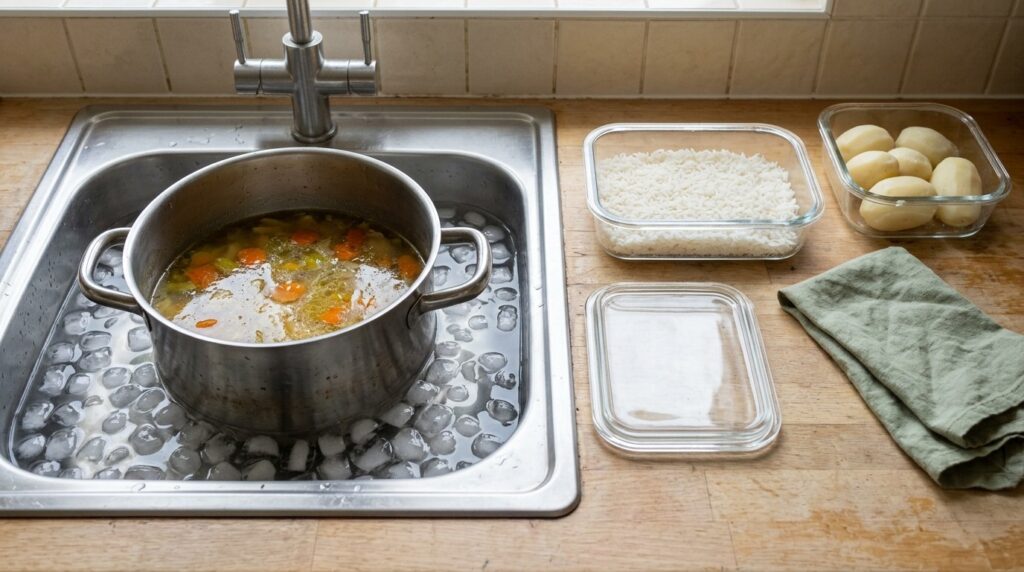
What I do with a big pot of soup, broth or slow-cooked meat: it goes straight into the sink, in cold water. Stir it now and then so the heat gets out, and add ice if you have some. The USDA describes the same thing (an ice or cold water bath, then the fridge), and so does splitting a big batch over shallow containers.
Don’t let it stand for hours to cool down. There’s no need, and the food deserves better. The sooner it’s cold and in the fridge, the longer it stays good.
The plain rule for everything cooked: 2 hours on the counter at most, 1 hour on a hot day. Fridge at 40 F (4 to 5 C) or colder, freezer at 0 F (-18 C).
Leftovers: the US says 3 to 4 days, the UK says 2. I use 2 and freeze the rest. Take out the portion you’ll eat and reheat that, once.
3 fridge traps
Deli meat, soft cheese, smoked fish, pre-cut melon. Listeria keeps growing at fridge temperature, so a long stay in the fridge is the risk. It’s rare and it’s serious: about 1,600 cases and around 255 deaths a year in the US. Diabetes is on the risk list. Heat deli meat and smoked fish until they steam, or skip them.
Tuna and mackerel that got warm. Bacteria turn part of the flesh into histamine. Cooking, freezing and canning don’t remove it, and the fish can look and smell normal. It hits like an allergy within the hour: flushing, headache, itching. Buy it cold, keep it cold.
Home-made herb or garlic oil. Low acid and no air is what botulism needs. Fridge, and out after 4 days. (Fresh garlic is on my never list anyway.)
Folklore you can drop
“Never reheat spinach.” The worry is nitrite, and it’s a baby problem. Germany’s risk institute says the acute risk for adults is practically nil, and the European warning is about infants and toddlers. Don’t feed reheated spinach to a baby. You can eat it.
“Reheated mushrooms, eggs and chicken are toxic.” No food agency says so. UK advice allows reheating cooked meat once, and US charts list poultry and egg dishes as normal 3 to 4 day leftovers. Fridge fast, reheat once.
Green potatoes, though, are real. Green skin and sprouts carry solanine, which causes vomiting and diarrhea, and cooking only removes part of it. Cut green parts and sprouts away generously. Bitter potato dish: stop eating.
The short version
One more thing. Sudden strong pain in the upper belly with vomiting can be a flare as easily as bad rice. Follow your own flare plan and get help the way you normally would.
I’m a patient, and this is what I found and what I do. It doesn’t replace your doctor or your diabetes team.
Sources
I checked every claim against 2 sources or more. The list, per section:
Why I take the stricter rule
- People at Increased Risk for Food Poisoning. CDC. cdc.gov
- People who are at higher risk of food poisoning. Food Standards Scotland. foodstandards.gov.scot
- Pancreatogenic (Type 3c) Diabetes. Pancreapedia, American Pancreatic Association. pancreapedia.org
- Ewald N, Hardt PD. Diagnosis and treatment of diabetes mellitus in chronic pancreatitis. World J Gastroenterol 2013. wjgnet.com
- Hassing RJ et al. Proton pump inhibitors and gastroenteritis. Eur J Epidemiol 2016. link.springer.com
- Hafiz RA et al. The Risk of Community-Acquired Enteric Infection in Proton Pump Inhibitor Therapy. Ann Pharmacother 2018. gbhi.org
Washing rice, bulgur and lentils
- Do you need to wash rice before cooking? Here’s the science. The Conversation. theconversation.com
- Should You Rinse Rice? The Science of Cooking Rice. FoodCrumbles. foodcrumbles.com
- Research reveals plastic levels in food staples. University of Queensland, 2021. news.uq.edu.au
- Lentils food fact sheet. Montana State University Extension. montana.edu
- Beans and lentils. Ohio State University Extension. fcs.osu.edu
Rice and Bacillus cereus
- Home food fact checker. Food Standards Agency, GOV.UK, updated 21 Aug 2026. gov.uk
- Rice. Food Standards Scotland. foodstandards.gov.scot
- Preventing Foodborne Illness: Bacillus cereus (FS269). University of Florida IFAS Extension. ask.ifas.ufl.edu
- Re-Heating and Re-Eating Food. South Dakota State University Extension. extension.sdstate.edu
- Review on cereulide. Foods 2023, 12(4), 833. mdpi.com
- Scallan E et al. Foodborne Illness Acquired in the United States: Major Pathogens. Emerging Infectious Diseases 2011, CDC. wwwnc.cdc.gov
- Naranjo M et al. Sudden death of a young adult associated with Bacillus cereus food poisoning. J Clin Microbiol 2011. sciensano.be
- Leftovers and Food Safety. USDA Food Safety and Inspection Service. fsis.usda.gov
- Cold Food Storage Chart. FoodSafety.gov. foodsafety.gov
Cooled potatoes, rice and pasta
- Carbs and cooking. Diabetes UK. diabetes.org.uk
- Understanding resistant starch. Diabetes Canada. diabetes.ca
- Sonia S et al. Effect of cooling of cooked white rice on resistant starch content and glycemic response. Asia Pac J Clin Nutr 2015. apjcn.qdu.edu.cn
- Fernandes G et al. Glycemic index of potatoes commonly consumed in North America. J Am Diet Assoc 2005. agris.fao.org
- Leeman M et al. Vinegar dressing and cold storage of potatoes lowers postprandial glycaemic and insulinaemic responses in healthy subjects. Eur J Clin Nutr 2005. nature.com
- Patterson MA et al. Chilled Potatoes Decrease Postprandial Glucose, Insulin, and GIP Compared to Boiled Potatoes in Females with Elevated Fasting Glucose and Insulin. Nutrients 2019. mdpi.com
- Rogowicz-Frontczak A et al. Does Resistant Starch Formed by Cooling Pasta Decrease the Postprandial Glycemic Response in Type 1 Diabetes? Nutrients 2026. mdpi.com
- Hodges C et al. Method of Food Preparation Influences Blood Glucose Response to a High-Carbohydrate Meal. Foods 2020. westminsterresearch.westminster.ac.uk
- Strozyk S et al. Influence of resistant starch resulting from the cooling of rice on postprandial glycemia in type 1 diabetes. Nutrition & Diabetes 2022. doaj.org
Mold
- Molds on Food: Are They Dangerous? USDA Food Safety and Inspection Service. fsis.usda.gov
- Mould in foods: health risks and how to avoid them. German Federal Institute for Risk Assessment (BfR), updated 24 Mar 2026. bfr.bund.de
- Mycotoxins fact sheet. World Health Organization, 2 Oct 2023. who.int
- Rychlik M, Schieberle P. Model studies on the diffusion behavior of the mycotoxin patulin in apples, tomatoes, and wheat bread. Eur Food Res Technol 2001. portal.fis.leibniz-lsb.tum.de
- Ollinger N et al. Mycotoxin contamination in moldy slices of bread is mostly limited to the immediate vicinity of the visible infestation. Food Chemistry: X 2024. pure.fh-ooe.at
- Trinh HMT et al. Alternaria alternata growth, toxinogenesis and mycotoxin migration in cherry tomato. Toxins 2026. esploro.umontpellier.fr
- Molds on Food. Washington State University Extension. wpcdn.web.wsu.edu
- Moldy cheese: Is it OK to eat? Mayo Clinic. mayoclinic.org
Toxins that survive reheating, cooling a big pot, leftovers
- About Staph Food Poisoning. CDC. cdc.gov
- Staphylococcus aureus. University of Nebraska-Lincoln Extension. food.unl.edu
- About C. perfringens Food Poisoning. CDC. cdc.gov
- Preventing Foodborne Illness: Clostridium perfringens (FS101). University of Florida IFAS Extension. ask.ifas.ufl.edu
- Preventing Food Poisoning. CDC. cdc.gov
- Refrigerator Thermometers: Cold Facts about Food Safety. FDA. fda.gov
- How to chill, freeze and defrost food safely. Food Standards Agency, GOV.UK, updated 7 Sep 2026. gov.uk
- Safe Storage of Leftover Food. NHS Forth Valley, 2023. nhsforthvalley.com
- Soup food safety. Texas A&M AgriLife Extension, Dinner Tonight. dinnertonight.tamu.edu
Fridge traps
- Foodborne Illness and Listeria monocytogenes. Penn State Extension. extension.psu.edu
- Smoked fish and risk of listeriosis in high risk groups. UK Health Security Agency, GOV.UK. gov.uk
- Preventing Listeria Infection. CDC. cdc.gov
- Food Poisoning from Marine Toxins. CDC Yellow Book. cdc.gov
- Scombroid (histamine) food poisoning. Queensland Government. qld.gov.au
- Botulism Prevention. CDC. cdc.gov
- Herbs and Vegetables in Oil (SP 50-701). Oregon State University Extension. extension.oregonstate.edu
Folklore
- Nitrite in spinach and other foodstuffs (Opinion 007/2010). BfR. bfr.bund.de
- EFSA assesses possible health risk for children from nitrate in leafy vegetables. EFSA, Dec 2010. efsa.europa.eu
- Solanine in potatoes: green and strongly germinating potato tubers should be sorted out. BfR, 2018. bfr.bund.de
- Glycoalkaloids in potatoes: public health risks assessed. EFSA, 11 Aug 2020. efsa.europa.eu