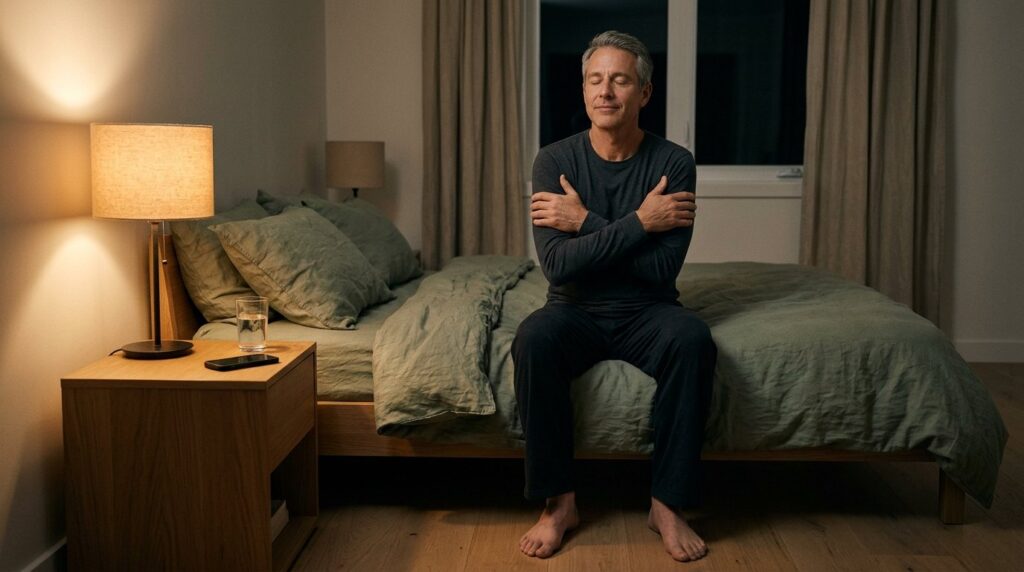
After my first hospital stay, anxiety ran my life for months. Every twinge in my belly felt like the start of the next attack.
So when Mission:Cure put two mental health experts in front of the pancreatitis community for an hour and let people ask anything, I watched the whole thing. Here’s the recording. Below it are the parts I think are worth your time, and what I’m keeping for myself.
Recording: Mission:Cure on YouTube, about an hour.
The webinar ran on 29 October. Mission:Cure’s director of patient advocacy, Shruthi Meera Shankar, hosted. She lives with pancreatitis, EPI and type 3c diabetes herself. Her two guests were Lara Govendo, a licensed clinical professional counselor who lives with cystic fibrosis and has had a double lung transplant, and Julie Wells, a trauma-informed peer support facilitator and trainer with Give an Hour, a US nonprofit for mental health support.
So all 3 people on screen know hospitals from the bed, or from the chair next to it. You can hear it.
The numbers are bad, and that’s the reason to talk about it
A US study of the health records of more than 30 million people found that people with chronic pancreatitis had about 7 times the odds of anxiety and 5 times the odds of depression, compared with people without it. A study of Taiwan’s national insurance data found the risk of a suicide attempt was about 2.7 times higher with chronic pancreatitis.
Shruthi’s line on it: mental health can’t be an afterthought in pancreatitis care. I’d go one step further. Put it on the same list as your enzymes and your fat budget, because it decides how well you manage the other two.
If you’re thinking about ending your life, please reach out today. US: call or text 988. Europe: 112 in an emergency, and many EU countries run an emotional support line on 116 123. UK and Ireland: Samaritans on 116 123. Anywhere else: findahelpline.com lists free lines by country.
The 2 a.m. toolkit, for people who are bad at meditating
I’ll be honest: I find meditation hard. My head won’t stop, I can’t sit still, or I fall asleep halfway. So the part I liked best was Lara’s live exercise, because none of it asks you to empty your mind.
Her point is simple. When you’re in pain, waiting for results or heading into another procedure, your nervous system drops into fight, flight or freeze. In her words, the brain takes the language of sensation. So you tell it you’re safe with your body.
- Ground. Feet flat on the floor, and let the chair carry your legs and back. Lying on the floor works fastest if you can. In a hospital bed, feel the mattress holding you.
- Orient. Look around and name what you see: colours, shapes, the picture on the wall. It pulls you back into this room and out of the replay of the last bad admission.
- Self-locate. Tap or rub your face, arms, legs and shoulders. Jaw, temples and neck hold the most tension.
- Breathe slower, with long exhales. Short, fast breaths keep you on alert. Opening the ribs and stretching the out-breath tells the body it can stand down.
- The containment hug. Cross your arms over your chest, so they cover your heart and lungs.
Two warnings came with it. Lara said breathing exercises calm some people and set others off, so test what works for your body. And Julie added something I’d never thought about: notice what your body already does when you’re anxious (she twists her hair), then tell the people close to you. They’ll spot it before you do.
Julie also explained why this has to be a daily thing. Pain pushes you into the reactive “lizard brain”, and in the middle of a flare you can’t learn anything new. Practise on an ordinary day, so the tool is already there on the bad one.
“Will I ever live normally again?”
Julie’s answer: normal was never fixed. Jobs, kids, moving house, a new dog. Life keeps changing, and pancreatitis is one more change your new normal has to make room for.
On social drinking she was practical. Tell friends specifically why you’re not drinking, and suggest a walk or a coffee instead of a night out. Saying “I can’t come” without a reason quietly pushes you away from the people you need. I don’t drink at all anymore, and I can confirm it gets easier the longer you do it.
For the days stuck in bed, Lara has had whole seasons of them, in bed and in hospital. She leaned on what she could still do: calling friends, writing, music, funny films. Julie’s tip is one I’m stealing. Save the series you’ve been waiting for for the bad days, so a bed day has something good in it.
Two more things stuck with me. Blaming yourself for a flare is very common, Julie said, even when you know better. And if you can’t work the way you used to, write down what work actually gave you (people, recognition, using your skills), then look for those things somewhere else.
Therapy beyond CBT
Someone asked what else there is besides cognitive behavioural therapy. Lara’s list: biofeedback, neurofeedback, EMDR, emotionally focused therapy, trauma-informed and somatic work, and narrative therapy, which helps you rewrite the story you tell yourself about your illness.
To find someone, she filters Psychology Today for chronic illness, chronic pain or rare disease, plus your insurance. Give an Hour also has therapists trained in rare disease. Julie’s rule is the one I’d keep: fit comes first. A therapist you trust and actually want to talk to beats a perfect specialty on paper, and Give an Hour runs a training series (Beyond the Diagnosis) that can bring a good therapist up to speed on chronic illness.
Psychology Today and insurance filters are a US thing. In Europe, ask your GP or your gastroenterologist for a referral, and ask by name for someone who works with chronic illness or medical trauma.
The ER, and the letter
The question that hit me hardest: dread of going to the ER because you’ll be seen as drug seeking. Anyone who has lain on a trolley waiting for pain relief knows that feeling.
What the panel suggested:
- Message your own specialist before you go (patient portal, or the on-call line), so the ER hears about you from a doctor.
- If a doctor in the ER doesn’t believe you, you’re allowed to ask for another one.
- Bring someone who knows your story and can speak when you can’t. Julie does this for her partner, and tells the staff she’s there to be on their team. She says it changes how they listen.
- Carry a letter from a doctor you trust, on the practice’s letterhead. Shruthi got this tip from one of Mission:Cure’s expert panelists. It names your diagnosis and its cause, your usual pain levels and the medication that works for you. She pointed out that amylase and lipase aren’t always raised, which is one reason pain gets doubted.
- In the US, ask for a note about your pancreatitis at the top of your chart in Epic, so every hospital on that system sees it.
I’d put that letter in your hospital bag, next to your enzymes and your phone charger.
Stepan’s Rule: ask for the ER letter on a good day. On a bad day you won’t be able to explain yourself, so let the paper do it.
The idea to take home
Shruthi closed with what she called your care ecosystem: your medical team, a mental health professional, the people at home, patient groups online and nearby. You don’t build that in a week. Asking for support is part of looking after yourself, the same as taking your enzymes.
I wrote about my own months of anxiety after my first admission in the anxiety you get discharged with, and about what meditation does in stress, rest and meditation. The book goes deeper on the mental side, including the professionals who helped me.
I’m a patient, not a doctor or a therapist. Treatment for anxiety, depression or pain belongs with your own care team.
In the PancreasZen community plenty of us know the 2 a.m. spiral. Come and tell us which of these tools works for you.
About Mission:Cure
Mission:Cure is a US nonprofit founded in 2017 by Megan Golden and her brother Eric, after years of trying to find treatment for Eric’s chronic pancreatitis pain. It brings patients, families, scientists, clinicians and drug developers together around one goal: a cure for pancreatitis. I like them because they do the research side and the patient side at the same time.
- Research and trials. They push new research and drug development, and keep a list of pancreatitis clinical trials you can join.
- The FDA. They were accepted into the FDA’s Rare Disease Endpoint Advancement Pilot Program, to build a patient-reported way of measuring flares in clinical trials. Right now there’s no established way to measure flares, so every company has to build its own before a trial can start.
- Free patient education. Webinars like this one, toolkits, a list of support groups and help with costs, all free on their resources page.
Free tools from Mission:Cure worth bookmarking if this article spoke to you:
- If you liked Lara’s exercise: a 10-minute guided meditation for pancreatitis pain led by Dr Christiane Wolf, and a gentle yoga guide that teaches diaphragmatic (belly) breathing.
- Mental health toolkits made with Give an Hour: part 1 (self-regulation, an emotion tracker, your support system) and part 2 (self-compassion, self-care, finding mental health support).
- The online support groups list.
- Their stress and pancreatitis webinar, with the EMDR and neurofeedback angle.
- The Johns Hopkins Pancreatitis Pain Program explained. The first visit there has to be in person, in Baltimore.
Want their webinars in your inbox? Join the Mission:Cure mailing list. And if you can spare something, donate to their research.
Sources
- Mission:Cure, Pancreatitis and Mental Health: Q&A With Mental Health Experts (webinar page and recording, 29 October 2026), and About us.
- Alkhayyat M. et al., Increasing prevalence of anxiety and depression disorders after diagnosis of chronic pancreatitis, Pancreas, 2021.
- Chen C.-H. et al., Suicide attempts and completed suicide in patients with chronic pancreatitis, Frontiers in Psychiatry, 2018.
- Give an Hour, giveanhour.org. Lara Govendo, Hungry 4 Hope Consulting.