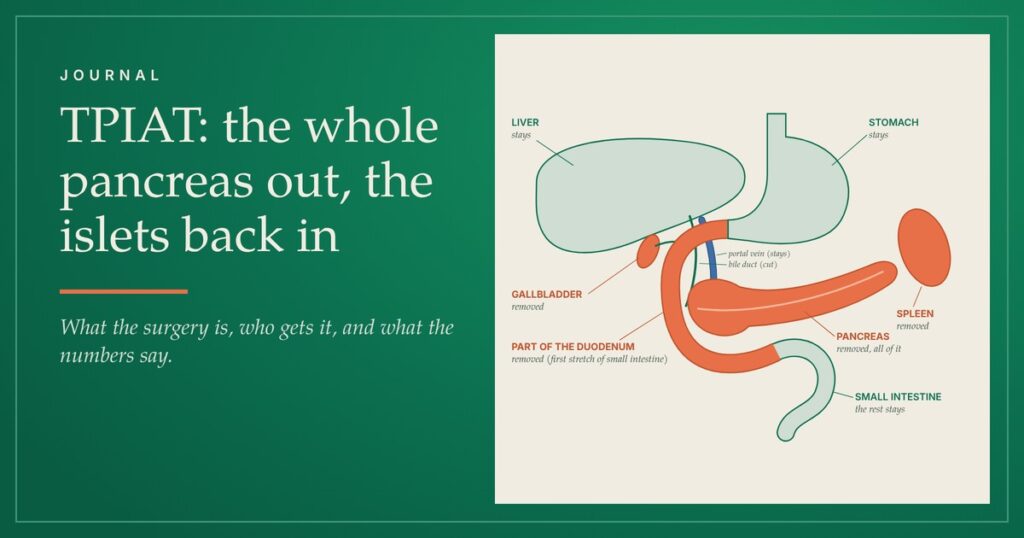
I’ve heard the letters TPIAT a couple of times now. Each time I nodded along and had no idea what it was.
So I sat down and read up on it.
I have pancreatitis and I haven’t had this operation. What follows is a patient reading the studies, with every source at the bottom. Take it to your own team before you take it anywhere else.
What the letters mean
Total pancreatectomy with islet autotransplantation.
The surgeon takes out your whole pancreas. A lab pulls the insulin-making cells (the islets) out of it. The same day, those cells go back into you. They end up in your liver.
The logic is blunt. A pancreas that’s gone can’t hurt anymore. But a body without a pancreas makes no insulin at all, so the team saves as many of your own islets as it can.
The first one was done at the University of Minnesota in 1977. That patient stayed off insulin and free of pain until she died 6 years later, of something unrelated.
What comes out
More than the pancreas.
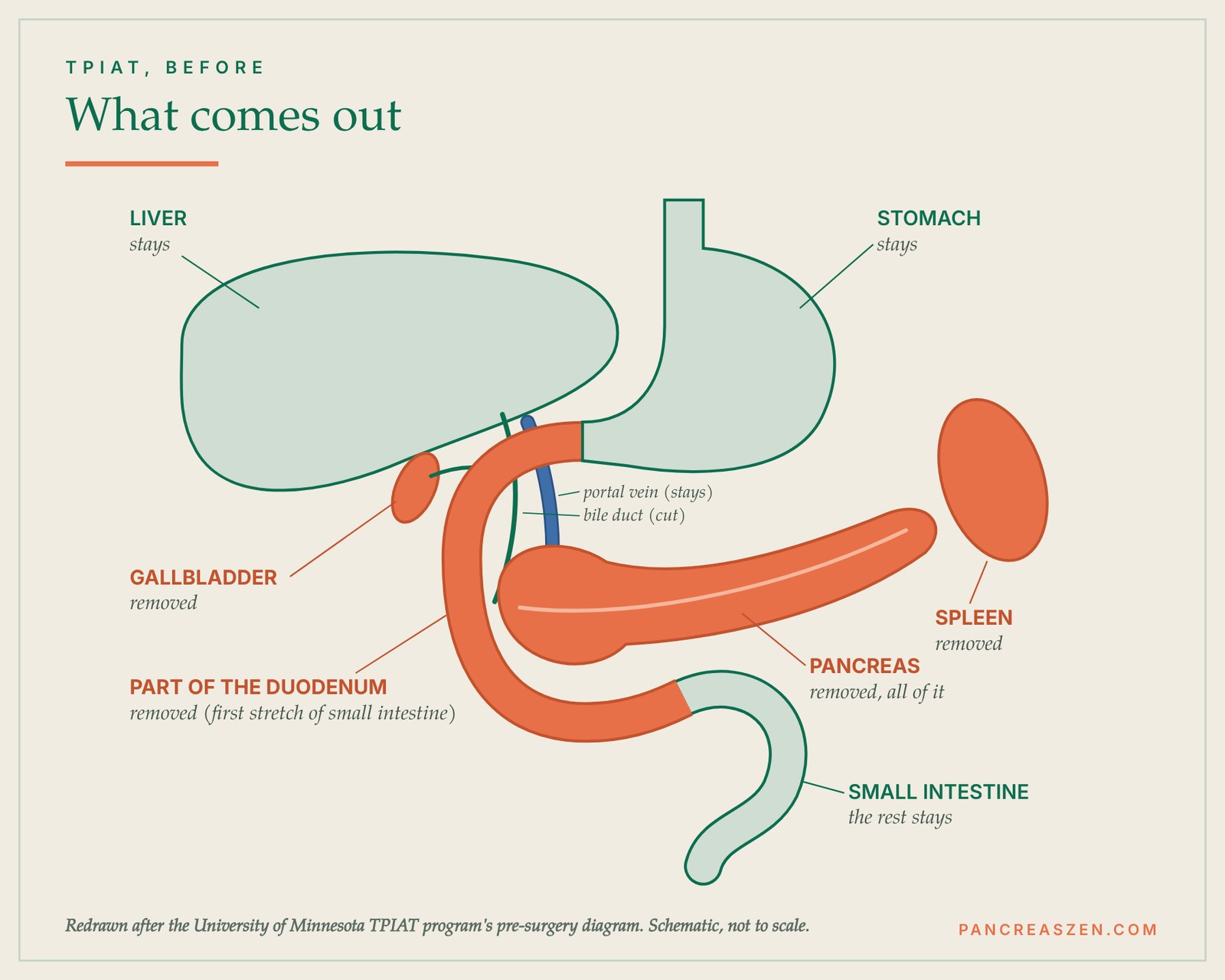
At Minnesota the surgeon also removes the spleen, the gallbladder and part of the duodenum (the first stretch of small intestine). They share blood vessels with the pancreas, so they go with it.
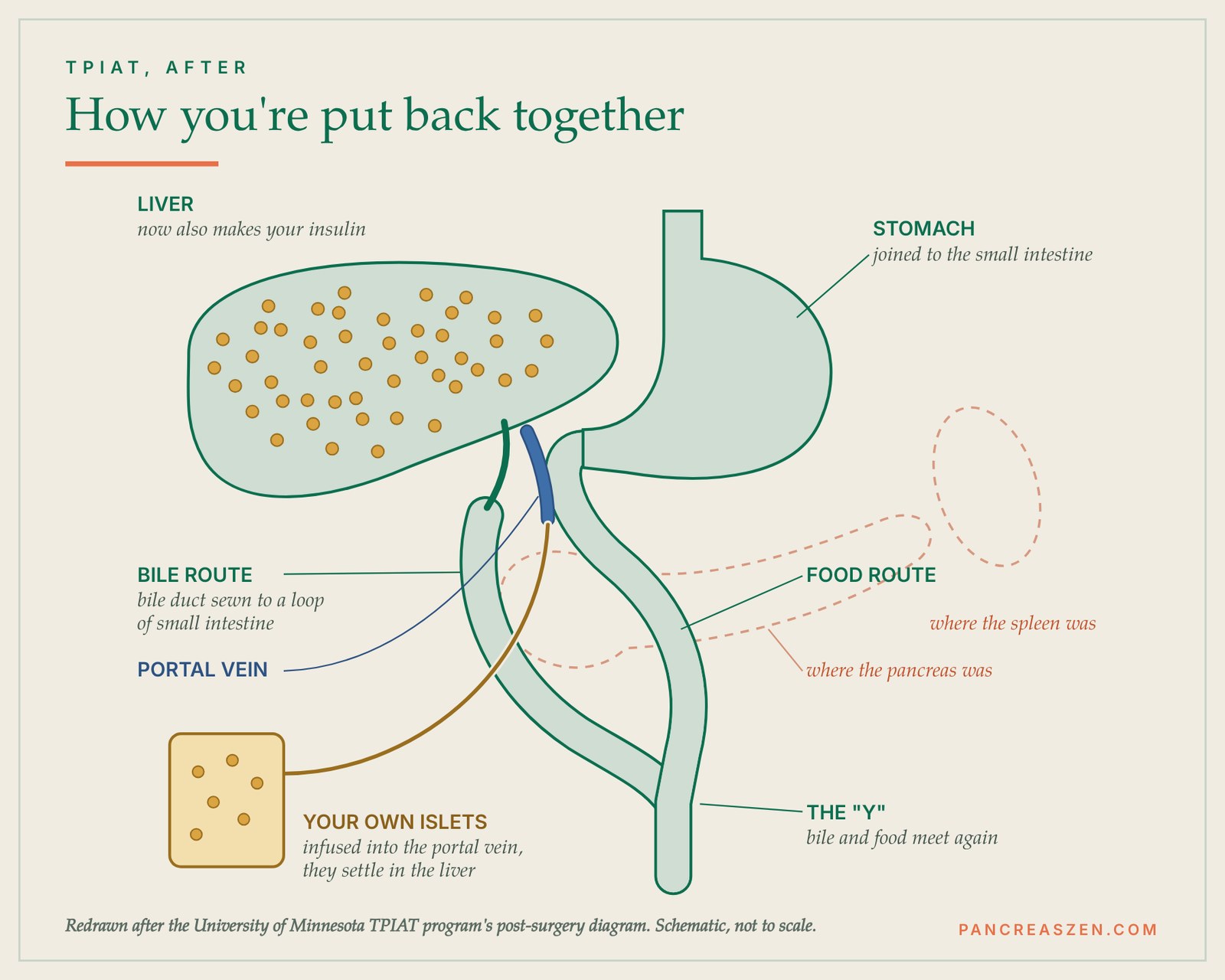
Then you get rebuilt. The stomach and the bile duct are sewn onto the small intestine in a layout surgeons call a Roux-en-Y. Food takes one branch, bile takes the other, and they meet again further down.
What happens to the islets
A healthy pancreas holds about 1 million islets. After years of pancreatitis you have a lot fewer.
While you’re still on the table, the pancreas goes to a lab. An enzyme dissolves the tissue that holds the islets in place and a chamber shakes them loose. A few hours later they’re infused into the portal vein, the vessel that runs to the liver. They lodge there and start making insulin again.
They’re your own cells. So you need no anti-rejection drugs, which is the big difference with a transplant from a donor.
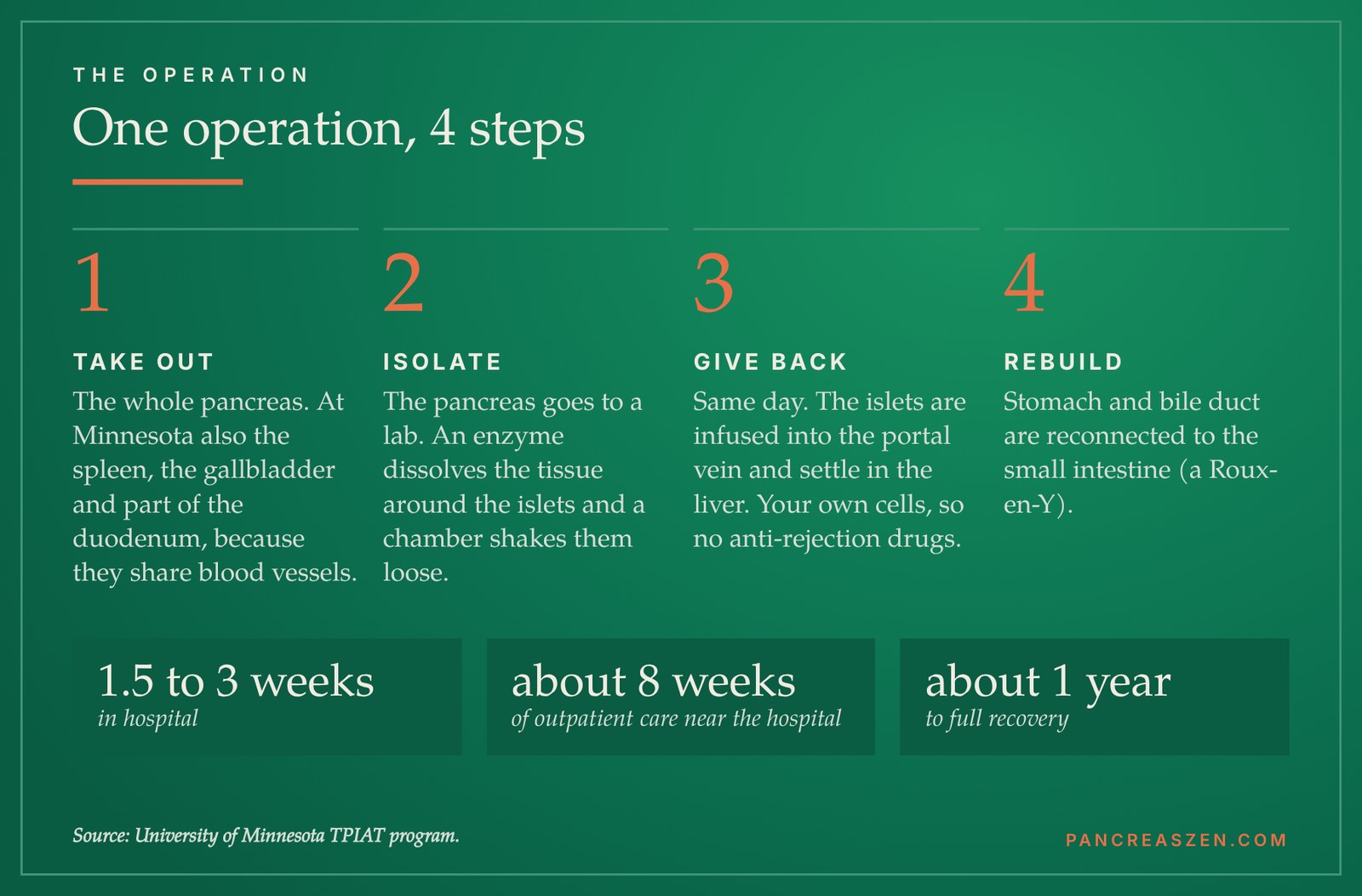
Minnesota’s own planning numbers: 1.5 to 3 weeks in hospital, about 8 weeks of outpatient care close to the hospital, and about a year until you’re fully recovered.
Who gets it
Very few people. I guessed it was a last resort, and it is.
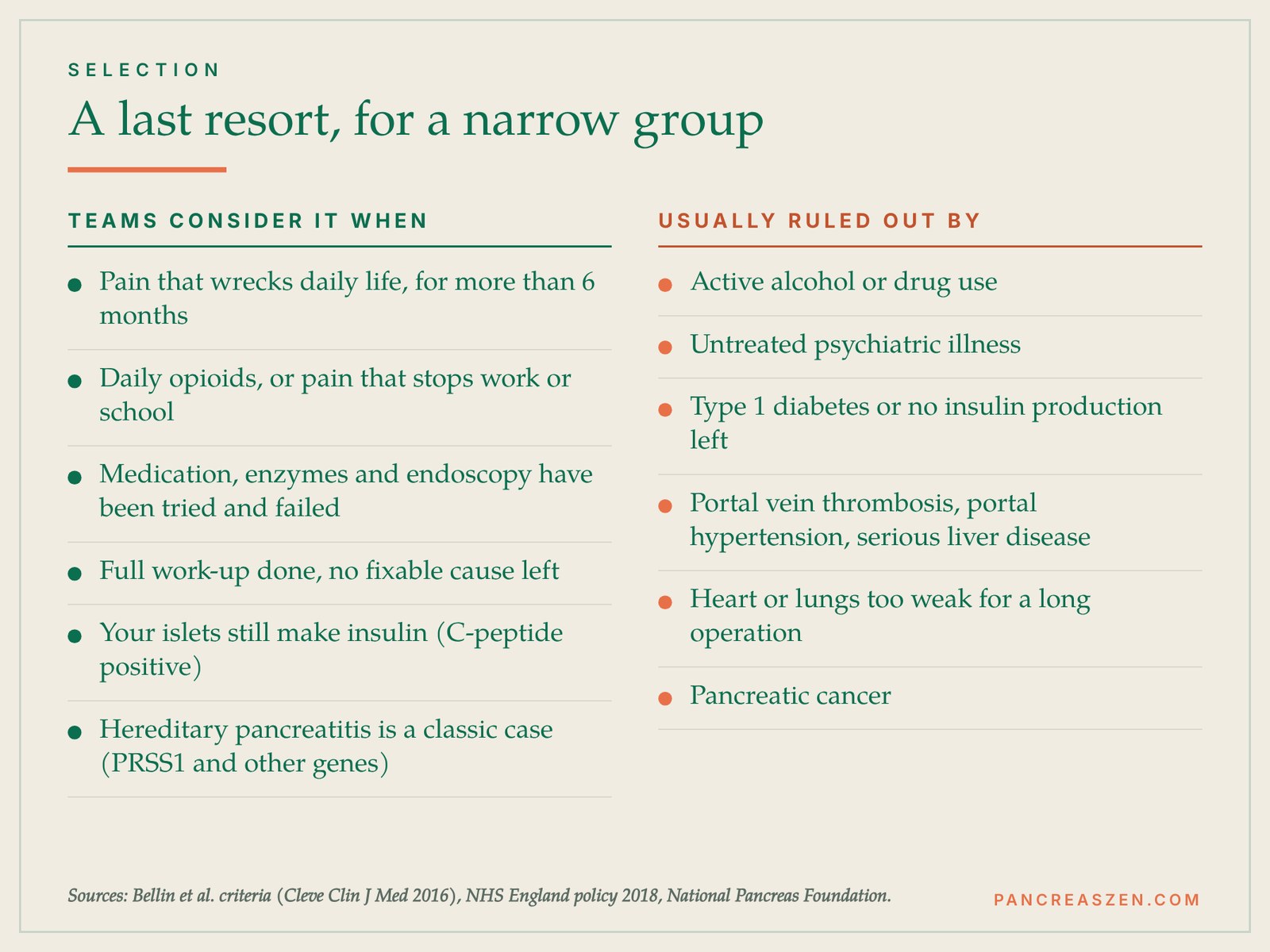
Teams consider it when the pain has wrecked daily life for more than 6 months, you’re on daily opioids or can’t work or go to school, and medication, enzymes and endoscopy have all been tried. Your islets still have to work, which they check with a blood test for C-peptide.
Hereditary pancreatitis is the classic case. If your genes keep setting the pancreas on fire, there’s little else to fix. That’s also why children get this operation.
It’s not offered after a single attack, however bad that attack was.
And the list of what rules you out is long: active alcohol or drug use, untreated psychiatric illness, type 1 diabetes, a clot in the portal vein, serious liver disease, a heart or lungs that won’t carry a long operation, pancreatic cancer. On alcohol the experts call abstinence mandatory. Zero means zero here too.
What the numbers say
Pain first, because pain is the reason anyone does this.
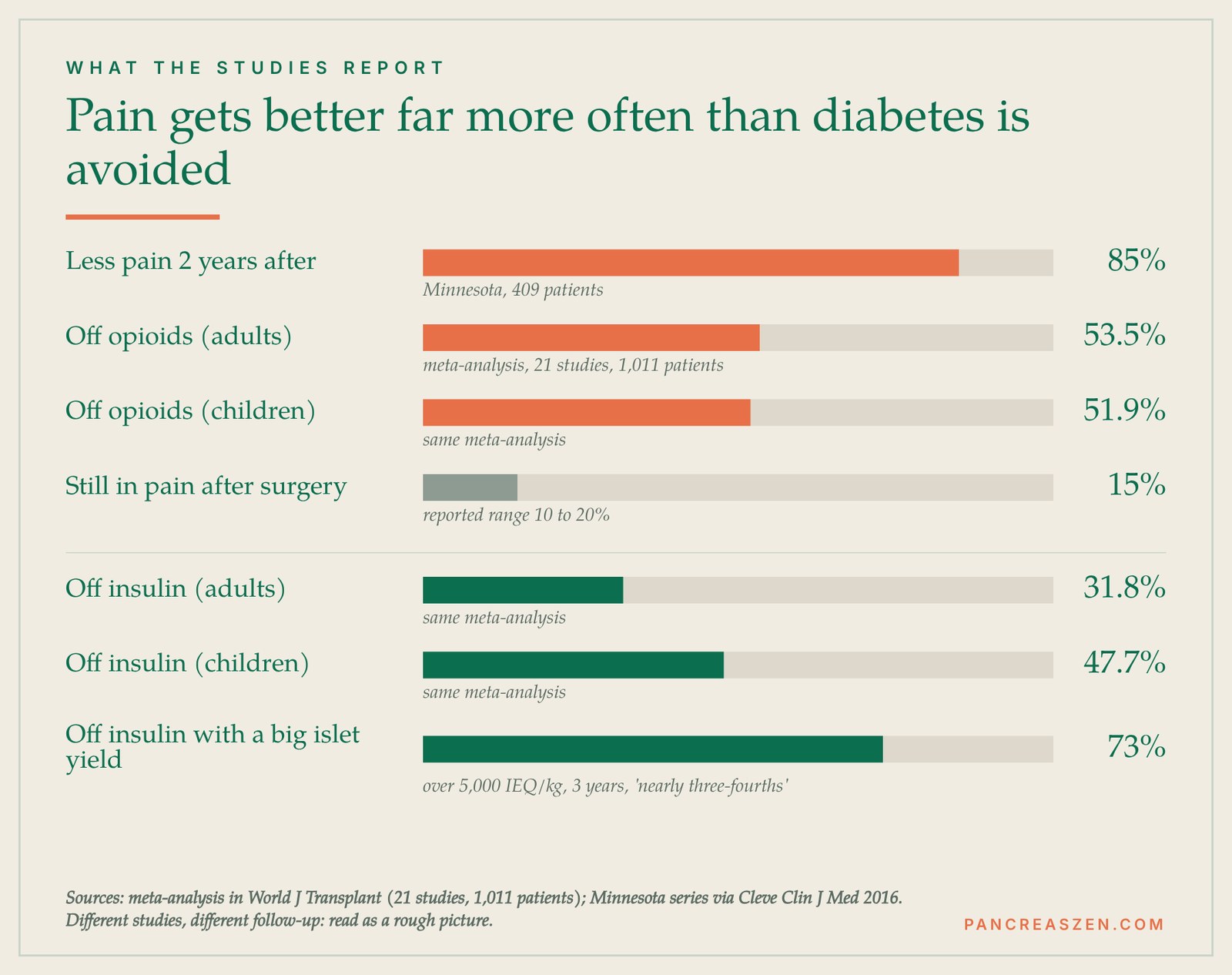
In the Minnesota series of 409 patients, 85% had less pain 2 years on. A meta-analysis of 21 studies and 1,011 patients found that 53.5% of adults came off opioids completely. In children it was 51.9%. At Cincinnati Children’s, opioid use among 69 kids dropped from 61% before surgery to 9% six months after.
Now the part the brochures say more quietly. Between 10 and 20% of patients still have pain afterwards, with no pancreas left to blame. Years of pain and opioids can rewire how the nervous system handles pain, and surgery doesn’t undo that.
Johns Hopkins looked closely at 46 of its own patients. The old pancreas pain was gone in 89%. But 83% described a new kind of belly pain, and 46% got off opioids.
Hospital time drops hard, though. The POST study follows 380 patients from 12 US centers. In the 18 months before surgery, 86.8% had been admitted to hospital. In the second year after, 31.2% were. The median number of days in hospital went from 8 to 0.
Then diabetes. In that same meta-analysis 31.8% of adults and 47.7% of children needed no insulin. At Minnesota, 3 years out, 30% were off insulin, 33% had islets that worked partly, and 37% depended fully on insulin.
The PancreasFest expert group puts it bluntly: your risk of diabetes after TPIAT is at least 60%, so the surgery shouldn’t be done just to prevent diabetes.
How many islets the lab recovers decides most of it. Patients who got more than 5,000 islet equivalents per kilo of body weight: nearly three quarters were off insulin at 3 years.
And the risk. This is major surgery. One analysis of 317 patients counted major complications in 41%. Minnesota reports 1.2% deaths in hospital; the evidence review behind the NHS England policy puts deaths within 30 days at 2.1 to 5%. Long-term survival in the Minnesota series: 97% at 1 year, 90% at 5 years, 81% at 10. In POST, about 38% needed another abdominal operation within 4 years.
And it can’t be undone. If a better treatment for pancreatitis pain shows up in 10 years, you can’t use it.
These numbers come from different studies with different follow-up. Read them as a rough picture.
Timing matters more than I expected
Every earlier operation on the pancreas costs islets. People who’d already had part of their pancreas removed had about 50% fewer islets to harvest.
The international consensus guideline from 2020 says earlier surgery probably gives better results than late surgery. It also admits that head-to-head trials are missing. So “probably” is the right word.
What you sign up for afterwards
Enzymes with every meal, for life. You have no pancreas, so every gram of fat, protein and starch needs capsules.
Blood sugar checks for life, even if you’re off insulin today. Islets can wear out.
Blood tests for vitamins A, D and E, and bone density scans.
And you have no spleen. That means extra vaccines, and a fever becomes a reason to call a doctor the same day.
Where it’s done
A handful of countries, a few centres each.
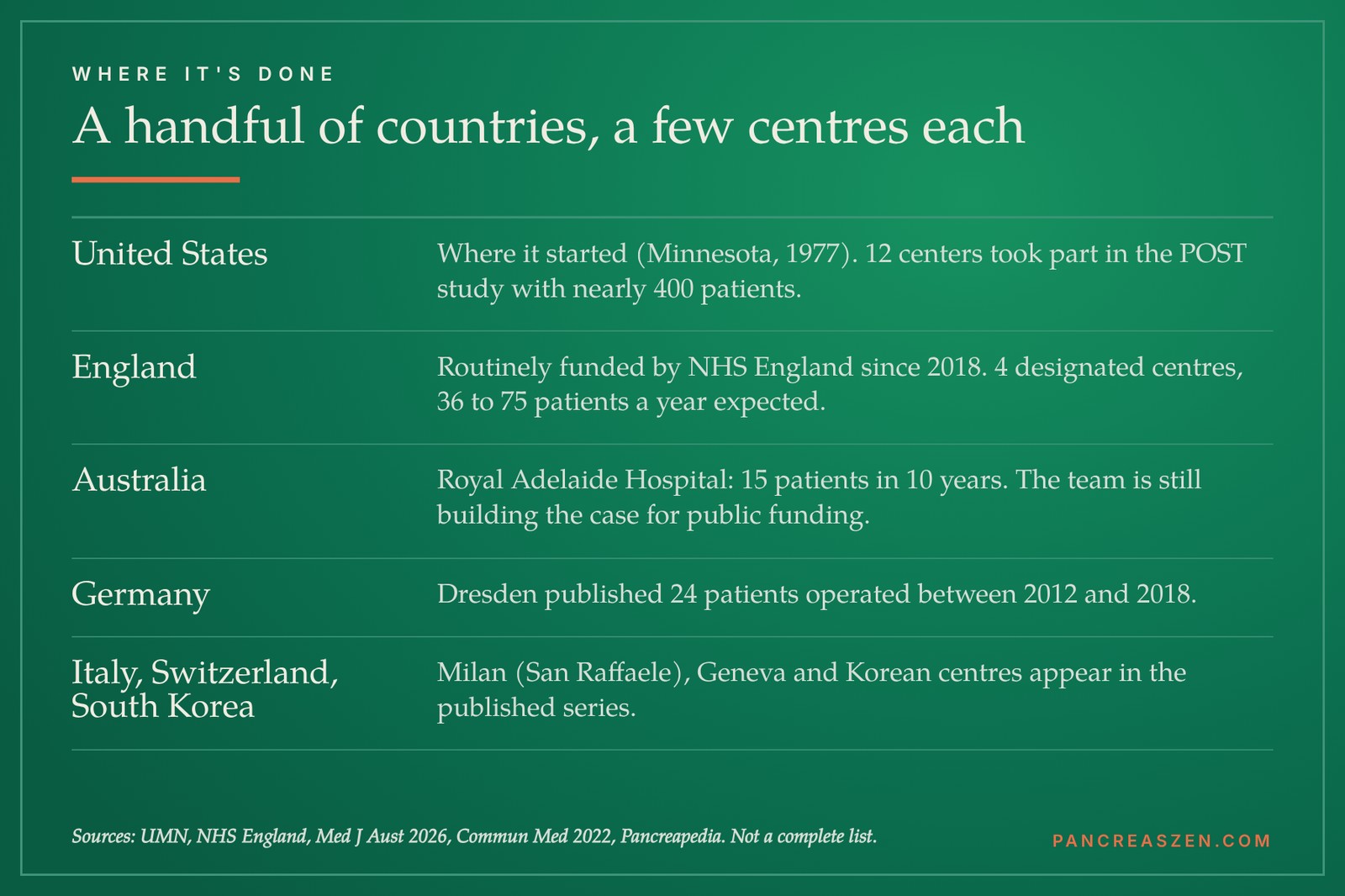
The United States does the most. 12 centers feed the POST study I quoted above. In England the NHS has funded it since 2018, at 4 designated centres, for an expected 36 to 75 patients a year. Australia has done 15 in 10 years at the Royal Adelaide Hospital, and the team there is still making the case for public funding. Dresden in Germany published 24 patients. Milan, Geneva and centres in South Korea show up in the published series too.
Most countries don’t offer it at all. It needs a surgeon who does pancreas removals often and an islet lab close enough to turn the organ around the same day.
What I take from it
If your pain team has run out of options, ask for a referral to a centre that does TPIAT. Ask early, before more of your pancreas has been cut away or burned out, because the islets you lose in the meantime don’t come back.
And go in knowing the trade. You swap a pancreas that hurts for capsules with every meal, a real chance of insulin, a body without a spleen, and a 1 in 10 to 1 in 5 chance that the pain stays anyway.
For someone whose life has shrunk to a bed and a pill box, that can be a good trade. Half of the adults in those studies got off opioids.
Have you had TPIAT, or been assessed for it? I’d like to hear how it went. There’s a free class on TPIAT in our Skool community here, and that’s where we talk about it.
Stepan
I’m a patient, not a doctor. This is what I found in the published sources below, checked on 3 October 2026. Take it to your own team.
Sources
- University of Minnesota, TPIAT surgery
- University of Minnesota, NIH and sponsored studies (POST)
- Bellin et al., Total pancreatectomy and islet autotransplantation in chronic pancreatitis: recommendations from PancreasFest, Pancreatology 2014
- Rates of hospitalization pre- and post-TPIAT (POST study, 380 patients), Surgical Endoscopy 2026
- Prevalence and predictors of pain and opioid analgesic use following TPIAT (Johns Hopkins, 46 patients), Pancreatology 2017
- National Pancreas Foundation, TPIAT
- Outcomes of total pancreatectomy with islet autotransplantation: a systematic review and meta-analysis, World Journal of Transplantation
- Total pancreatectomy and islet cell autotransplantation: definitive treatment for chronic pancreatitis, Cleveland Clinic Journal of Medicine 2016
- Total pancreatectomy with autologous islet cell transplantation: the current indications, Journal of Clinical Medicine 2021
- NHS England, Clinical Commissioning Policy: total pancreatectomy with islet auto transplant, 2018
- International Consensus Guidelines in chronic pancreatitis, the role of TPIAT, Pancreatology 2020
- Pancreapedia, Total pancreatectomy and islet auto transplantation for chronic pancreatitis
- TPIAT reduces opioid use and improves nutritional support in children, PLOS One (Cincinnati Children’s)
- Total pancreatectomy and islet auto transplantation in South Australia: a 10-year experience, Medical Journal of Australia 2026
- Quality of life and metabolic outcomes after total pancreatectomy and simultaneous islet autotransplantation (Dresden), Communications Medicine 2022