I’ve had 2 severe attacks, 2 and a half years apart. Since the second one I take the same question to every appointment: is this going to turn chronic?
I see that question in the pancreatitis groups every week. Somebody had one attack 10 years ago and nothing since. Somebody else is on attack number 6. And a third person got a chronic diagnosis without ever landing in an ER for it.
Same organ, 3 very different stories. So I went and read what the research says about why.
It’s one disease on a sliding scale
Doctors used to treat acute and chronic pancreatitis as 2 separate diseases. Most pancreas specialists now see them as points on one line.
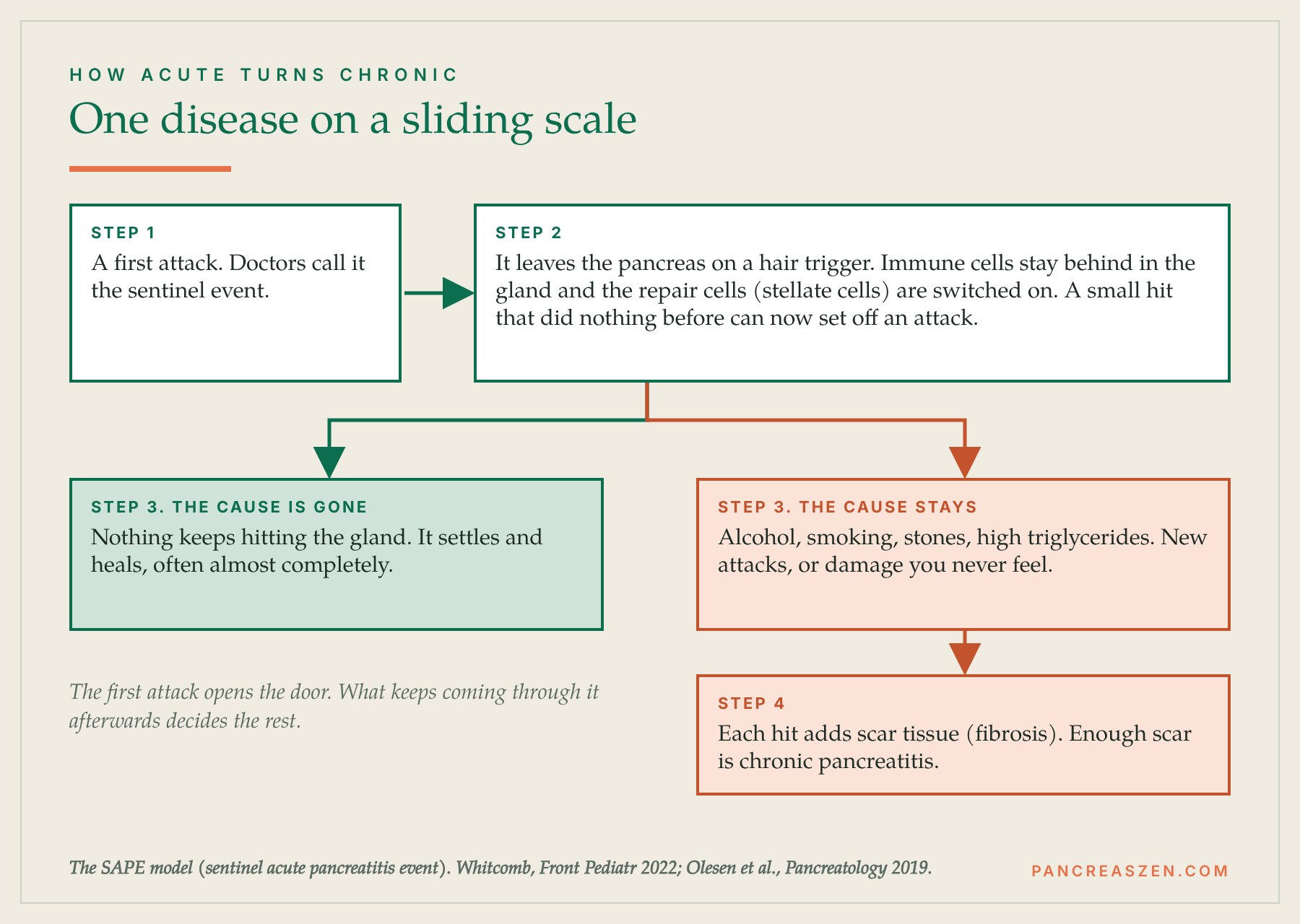
The working model is called SAPE, short for sentinel acute pancreatitis event. The first attack does the damage you feel. It also leaves the pancreas on a hair trigger: immune cells stay behind in the gland, and the repair cells (stellate cells) get switched on. A small hit that did nothing before can now set off a new attack.
What happens next depends on whether something keeps hitting the gland.
If the cause is gone, the pancreas settles and heals, often almost completely. If the cause stays, every new hit lays down more scar. And scar never turns back into working pancreas. Collect enough of it and you have chronic pancreatitis.
The numbers
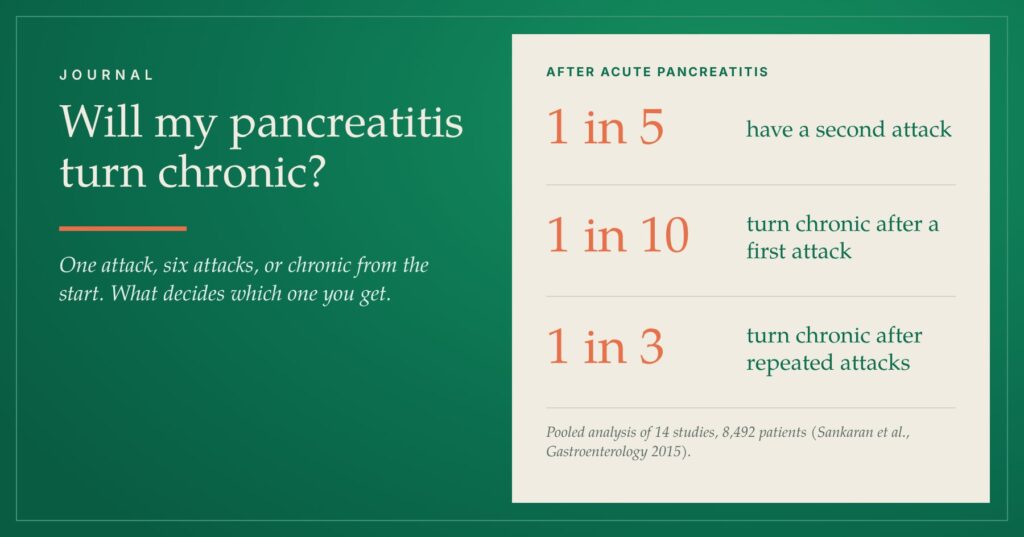
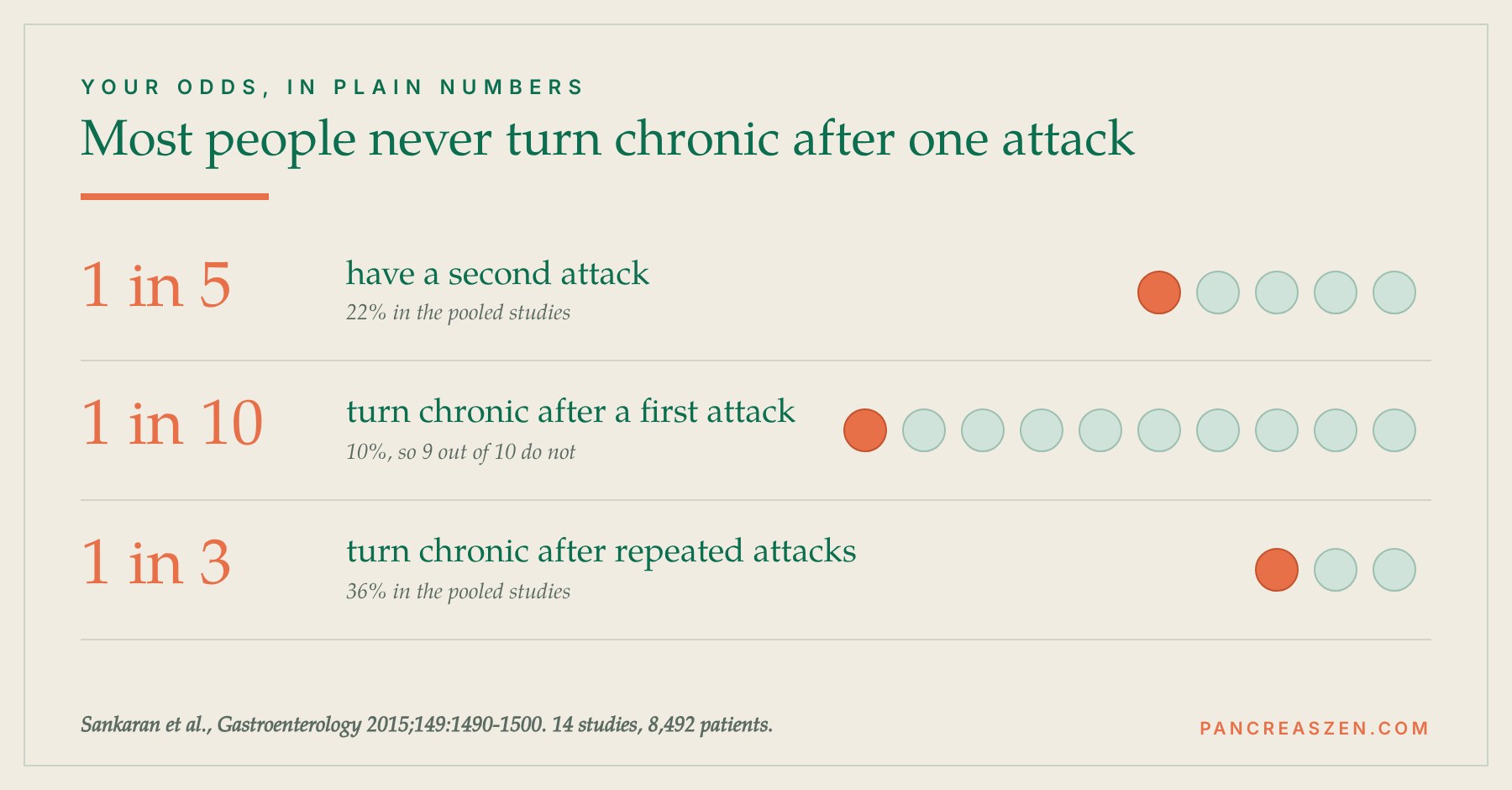
The biggest pooled analysis (Sankaran and colleagues, 2015: 14 studies, 8,492 patients) puts it like this. About 1 in 5 people have a second attack. About 1 in 10 go on to chronic pancreatitis after a first attack. After repeated attacks it’s about 1 in 3.
Turn that around: 9 out of 10 people don’t end up chronic after one attack.
What decides which road you take
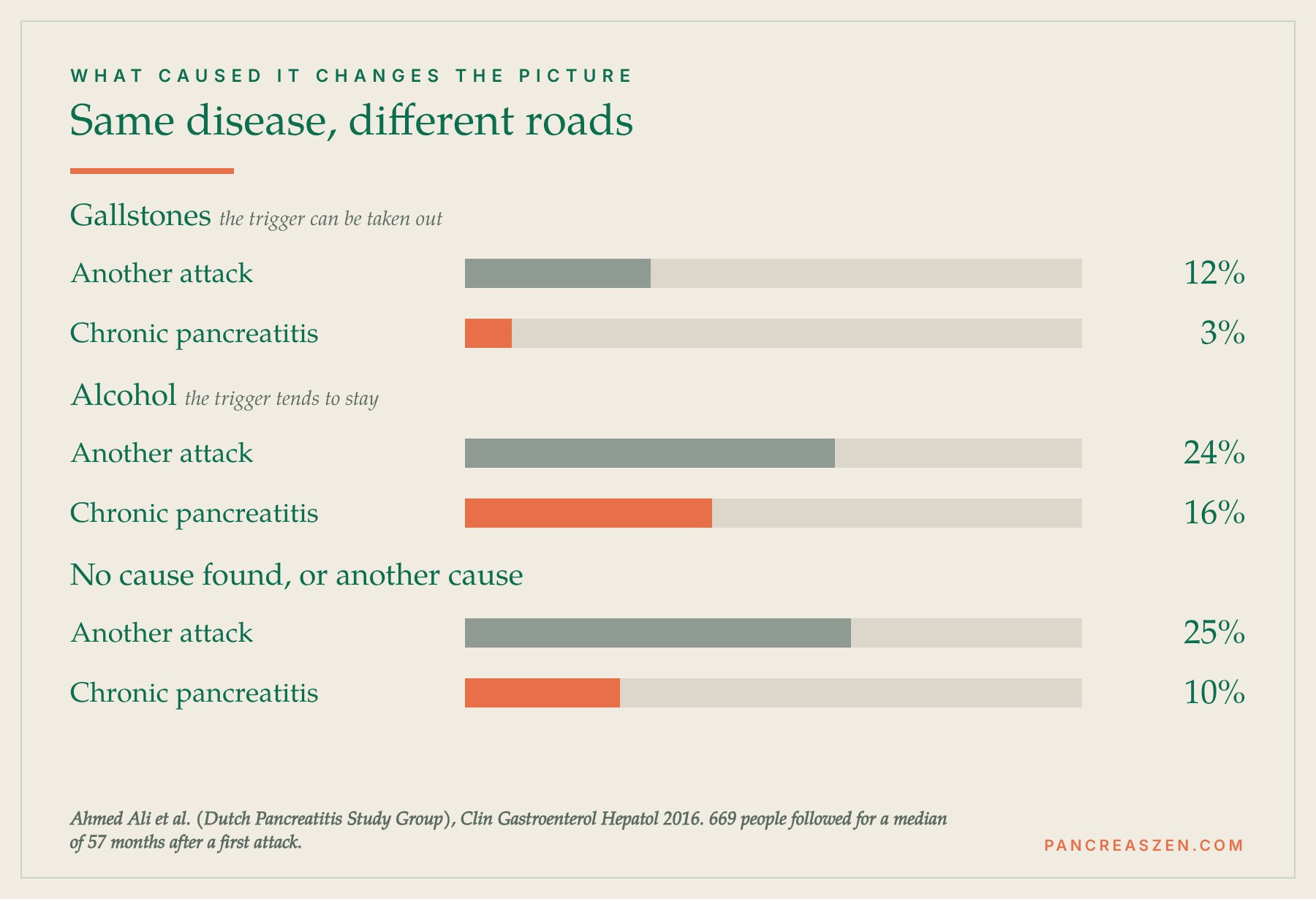
The cause. A Dutch study followed 669 people for almost 5 years after their first attack. 3% of the people with gallstone pancreatitis became chronic. With alcohol as the cause it was 16%.
Take the gallbladder out and the trigger is gone. In one comparison about 30% of people who kept their gallbladder had another attack, against about 11% of those who had it removed. Alcohol tends to stay.
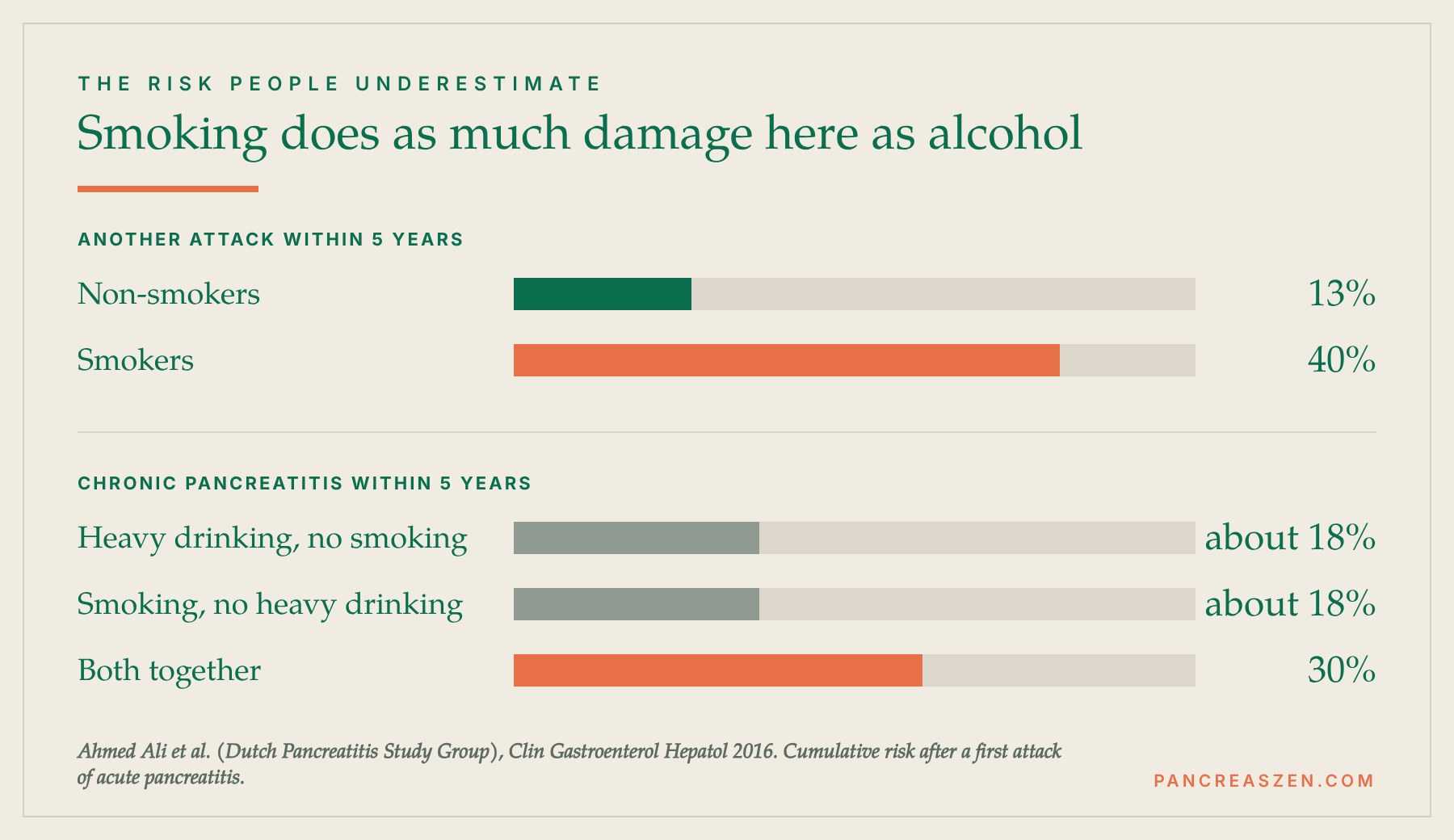
Smoking. This is the one I underestimated. In the Dutch study smokers had a 40% chance of another attack within 5 years. For non-smokers it was 13%. Heavy drinking alone or smoking alone gave roughly an 18% chance of chronic pancreatitis in 5 years. Both together: 30%.
I used to smoke, 20 a day at one point. I’ve quit cigarettes and I vape now. The next step is to quit everything. Those numbers are the best argument for it I’ve read so far.
Triglycerides. Fewer than 1 in 10 people with very high triglycerides ever have an attack. But once you’ve had one, at least a third quickly have another. That’s the hair trigger at work, and it’s a number a blood test and treatment can bring down.
Your genes. PRSS1, SPINK1, CFTR and CTRC are the ones doctors test for. They explain why 2 people with the same history end up in different places, and why only about 5% of heavy drinkers ever get pancreatitis at all. My father has pancreatitis too, so genetic testing is on my list for the next appointment.
Being a man. In the pooled analysis men moved from acute to chronic more often than women. Nothing you can do about that one.
How bad the attack was. Here the studies disagree. The pooled analysis found no clear link between the severity of the first attack and turning chronic. The Dutch study did find one for necrotizing pancreatitis, where part of the pancreas dies. Both of mine were necrotizing, so I count myself in the higher-risk group and get checked.
Chronic without ever having an attack
This part surprised me.
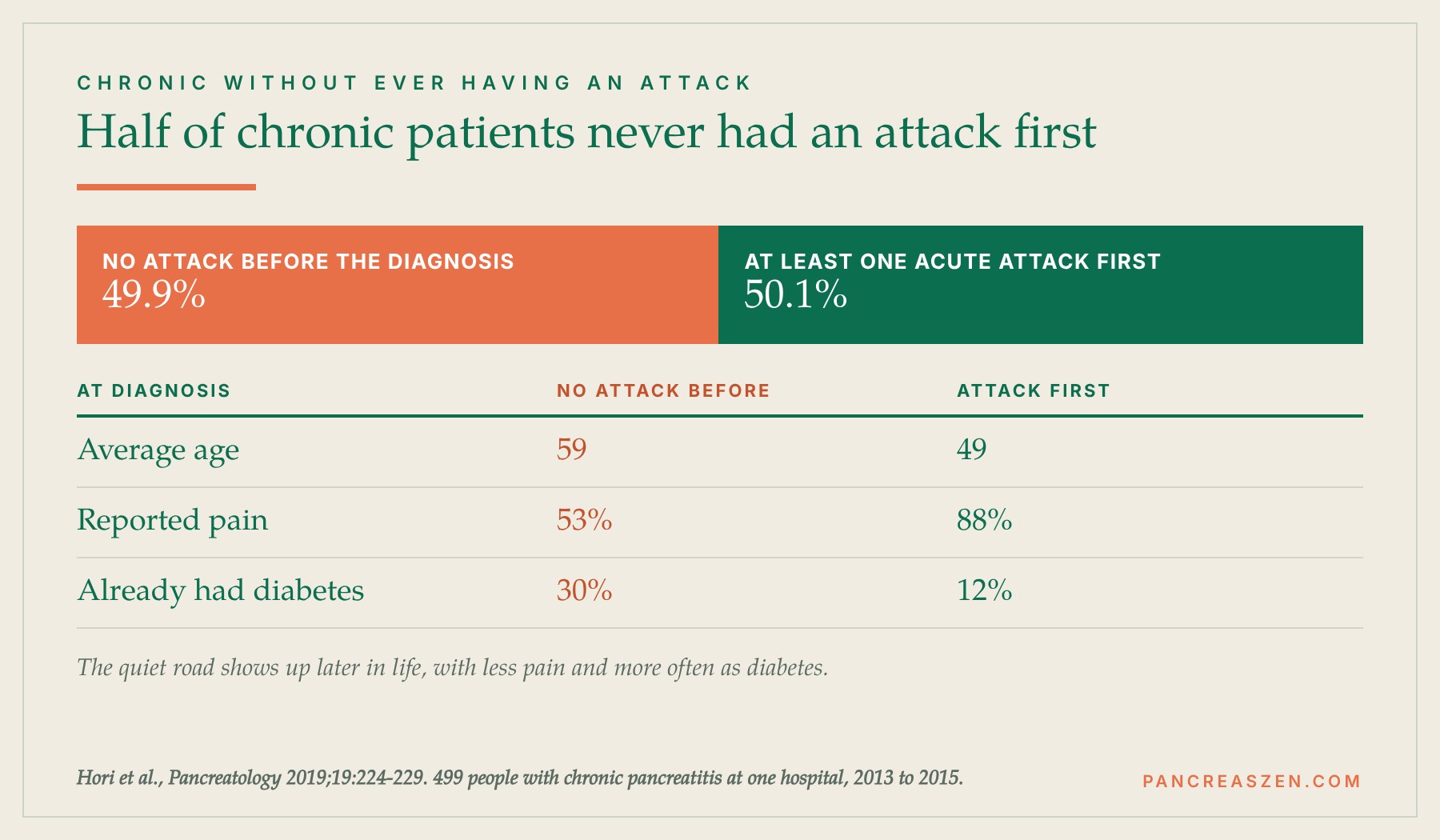
In a single-hospital study of 499 people with chronic pancreatitis, half had never been diagnosed with an acute attack before. A Danish group checked their own patients and found nearly the same: 180 out of 334 had a prior attack, so 54%.
The people on that quiet road were about 10 years older at diagnosis (59 against 49). Only about half of them reported pain, against 88% in the other group. And 30% already had diabetes, against 12%.
So “I never had a real attack” doesn’t rule chronic pancreatitis out. Pain in the upper belly that keeps coming back, oily stools, weight loss you can’t explain, or diabetes that shows up out of nowhere: say it to your doctor in those words.
What you can change, and what you can’t
You can’t change your genes or your sex. You can’t undo the damage that’s already there.
You can change the rest. Alcohol. Cigarettes. A gallbladder full of stones. Triglycerides that run high.
So I’d take 3 questions to your next appointment. What caused my attack? Is that cause gone? And how are you checking whether I’m moving toward chronic?
One more thing, because it gets mixed up a lot. After a severe attack you can lose enzyme or insulin function because part of the gland died. Lost tissue from one bad attack and chronic pancreatitis are 2 different diagnoses. Ask which one is written in your file.
Where to go from here
2 places, one free and one paid.
The free class. I turned all of this into a 5-lesson class in our Skool community: the odds per cause, the full risk list, the quiet road, and 6 questions for your next appointment. It’s free for every member, and joining is free too. Take the class: Acute, recurrent or chronic, where are you on the line?
The book. Chapters 4 and 5 cover recurrent and chronic pancreatitis, Part 4 goes through the causes one by one, and Chapter 18 is about the genes. Plus everything that comes after the diagnosis: what to eat, enzymes, flares, monitoring. Get the PancreasZen book.
Stepan
I’m a patient writing about my own experience and what I’ve read. Your own team knows your pancreas better than any article does.
Sources
- Sankaran SJ, Xiao AY, Wu LM, Windsor JA, Forsmark CE, Petrov MS. Frequency of progression from acute to chronic pancreatitis and risk factors: a meta-analysis. Gastroenterology 2015;149(6):1490-1500.e1. doi:10.1053/j.gastro.2015.07.066
- Ahmed Ali U, Issa Y, Hagenaars JC, et al. (Dutch Pancreatitis Study Group). Risk of recurrent pancreatitis and progression to chronic pancreatitis after a first episode of acute pancreatitis. Clin Gastroenterol Hepatol 2016;14(5):738-746. doi:10.1016/j.cgh.2015.12.040
- Whitcomb DC. Central role of the sentinel acute pancreatitis event (SAPE) model in understanding recurrent acute pancreatitis (RAP): implications for precision medicine. Front Pediatr 2022;10:941852. doi:10.3389/fped.2022.941852
- Hori Y, Vege SS, Chari ST, et al. Classic chronic pancreatitis is associated with prior acute pancreatitis in only 50% of patients in a large single-institution study. Pancreatology 2019;19(2):224-229. doi:10.1016/j.pan.2019.02.004
- Olesen SS, Drewes AM, Novovic S, Nøjgaard C. The sentinel acute pancreatitis event hypothesis revisited. Pancreatology 2019;19(4):614-615. doi:10.1016/j.pan.2019.03.007