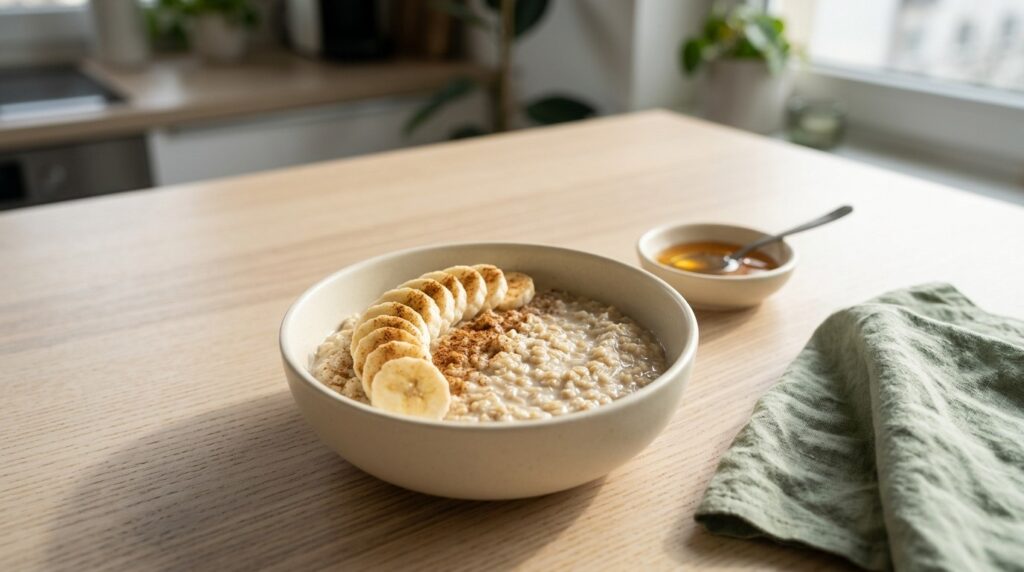
Yes. Oats were on my Phase 1 list and they’re still breakfast 3 or 4 mornings a week.
A bowl of oats is about as kind as food gets to an irritated gut: warm and soft. The grams move with what you cook it in.
The fat math
40 g of dry oats: about 2.5 g of fat. Cooked in water, that’s the whole bowl.
Cooked in 200 ml of 1.5% milk: add about 3 g, so about 5.5 g total. Still comfortably inside a strict day (20 to 30 g a day while I’m strict, 40 to 50 g once things have settled). Add a tablespoon of peanut butter and the bowl jumps by about 8 g, which is when it becomes a Phase 2 breakfast on my sheet.
Granola is the trap. It’s Phase 1 on my list, but store granola is baked in oil and can hit 10 g or more per 50 g serving. Read the label; some brands are 3 g, some are 12 g.
Which phase
Oats: Phase 1. Low-fat milk, cinnamon, honey: all Phase 1 for me, so the standard bowl never leaves Phase 1.
Your gut has its own opinion. Listen to it, and to your team.
How I actually eat it
40 g oats, water or 1.5% milk, cooked soft. Half a banana sliced in, cinnamon, a teaspoon of honey.
On a flare day: oats in water only, no toppings, a little salt. Overnight oats in low-fat yogurt in summer. Same grams, colder.
Questions people ask me
Can I eat oatmeal during a pancreatitis flare?
Plain oats cooked in water were one of my flare-day foods: about 2.5 g of fat for a 40 g bowl, warm and soft. I leave off the milk and toppings on those days.
Are overnight oats OK with pancreatitis?
Yes, same grams as cooked oats. I soak 40 g in 150 g of low-fat yogurt overnight, which adds about 2 g of fat. Everything in that jar is Phase 1 for me.
Is granola OK with pancreatitis?
Granola is Phase 1 on my list, but store brands are baked in oil and range from about 3 g to 12 g of fat per 50 g. I read every label and pick the low end.
Read on
The full phase lists and the fat budget are in the book. For a plate that uses this: the oatmeal with banana and cinnamon. More answers like this one: all food questions.
Not medical advice. This page reflects one patient’s low-fat approach grounded in published guidance. Fat tolerance is individual. Check with your own healthcare team before changing your diet.