Blood, a scan, a drip, no food, and the question about alcohol. From the hospital bed the first days of an attack can feel random. There’s a list behind them, and this video is that list.
Conan Liu is an American internal medicine doctor who makes videos about life in residency. In June 2022 he filmed the way he teaches acute pancreatitis to interns and medical students: 12 minutes, one hand-drawn table, the questions juniors get quizzed on during ward rounds.
I watched it as a patient and I think every one of us should. It’s the checklist your team runs while you’re lying there. You’ll see why they asked about your drinking, why your blood came back “thick” on day 1 and why somebody wanted another CT on day 6.
Below is his lecture in plain words, with my notes from the other side of the bed. One part of it went out of date 3 months after he filmed it. I’ll get to that.
How they decide it’s pancreatitis
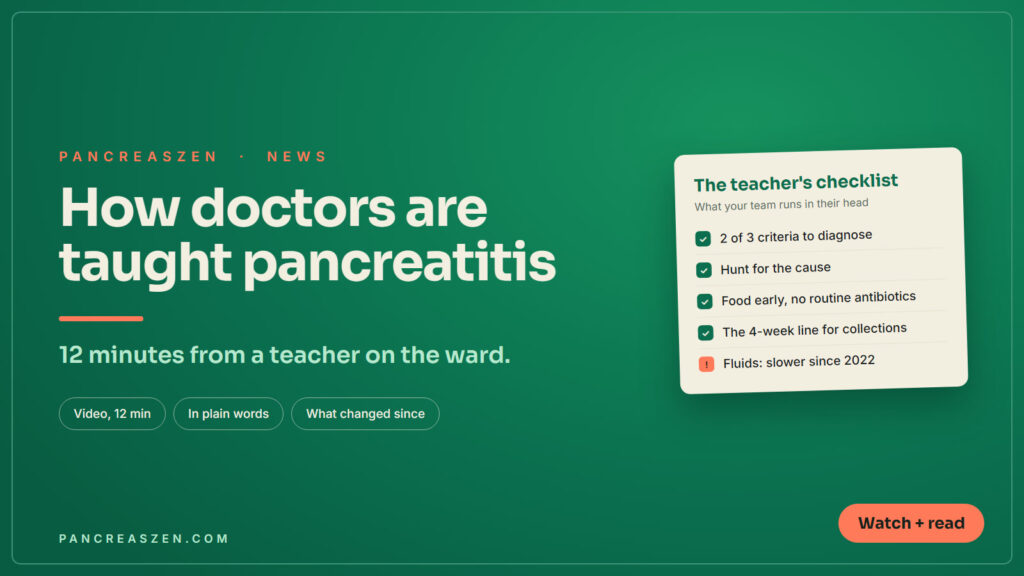
Two out of three. Typical pain high in the belly, often boring through to the back. Lipase or amylase in the blood above 3 times the normal upper limit. A CT or ultrasound that shows an inflamed pancreas. Two of those is enough, which is why a scan isn’t always the first thing that happens to you.
He adds 2 details I recognised straight away: nearly everyone with the pain also feels sick or throws up (he puts it at over 90%), and sitting up or leaning forward can take the edge off.
The cause hunt
Gallstones and alcohol are the top 2 causes. For the rare ones he teaches the old I GET SMASHED memory aid, and then admits he can’t remember all of it and looks it up every time.
He also warns his students about the scorpion sting. It’s a real cause, just a rare one, and it’s the classic trick question seniors fire at juniors on rounds. Doctors call that habit “pimping”.
The cause he says he has actually seen: triglycerides, the fat in your blood, above 1,000 mg/dL (about 11.3 mmol/L). His advice to students is to check a lipid panel on every pancreatitis patient. That’s the number I check now, too.
So when two different doctors ask how much you drink, that’s this part of the checklist. I wrote about how that question lands when you hear it from the bed.
Fluids and pain
His 2 pillars of treatment are “very, very aggressive” IV fluids and proper pain control. The protocol at his hospital: 1 litre of lactated Ringer’s in the first hour, then 250 ml an hour for 12 hours, then 150 ml an hour.
His explanation for the fluids is worth the 2 minutes on its own. The inflamed pancreas leaks digestive enzymes, they irritate the small blood vessels and the vessels start leaking too. Fluid moves out of your blood into the tissue around it, and you dry out from the inside even with a drip in your arm.
For pain it’s usually opioids, sometimes on a pump you press yourself (a PCA). He mentions one opioid, meperidine (pethidine in the UK and Europe), that exam questions like to name as “the best one for pancreatitis”, and says himself that the evidence for it isn’t strong.
Keep the fluid part in mind. It’s the part that changed.
Food and antibiotics
These are 2 “old practices” he tells his students to drop. Keeping patients strictly nil by mouth to rest the bowel doesn’t help, he says, and makes recovery longer. Start food as soon as possible, low fat, with clear liquids first if the pain is bad. And no antibiotics “just in case”: only when there’s a real infection to treat.
This is the part of the video that splits my 2 admissions down the middle. Krnov, May 2023: strict nil by mouth. Zlín, November 2025: a Nutridrink on day 3 (a sip feed, Ensure or Boost if you’re in the US). Same country, same diagnosis, 2 and a half years apart, and the second ward was working from his page. More on that in why they feed you sooner than they used to.
Why your blood looks strange on day 1
He teaches 2 scoring systems for predicting who’ll do badly, BISAP and the older Ranson’s criteria, and tells students to look them up on MDCalc rather than memorise them. BISAP stands for BUN (urea in your blood), impaired mental status, SIRS (the body-wide inflammation response), age and pleural effusion (fluid around the lungs).
Then the bit I found useful as a patient. People often come in with very high haemoglobin, he mentions 18 or 19, a high BUN and low calcium. The high numbers mean the blood is concentrated because so much fluid has leaked out of it. The drier you arrive, the worse you tend to do.
The low calcium has a stranger reason, and it was a question he got grilled on as a student. The enzymes break down fat around the pancreas, and the fatty acids grab calcium and turn into something close to soap. Doctors call it saponification.
The 4-week line
The last part is complications, and he sorts the fluid collections around the pancreas by one line: 4 weeks. Before 4 weeks they have no wall around them. After 4 weeks they’ve built one. In ordinary pancreatitis the walled version is a pseudocyst. In necrotizing pancreatitis, where part of the pancreas dies, it’s walled-off necrosis.
No symptoms usually means watch and rescan. Symptoms usually means drainage, most often through the stomach wall with an endoscope, and removal of the dead tissue (a necrosectomy) if that isn’t enough. The scans themselves are explained in what each pancreatitis scan actually sees.
The line I’d underline for anyone sitting next to a hospital bed: a patient who is better on day 3 or 4 and worse again on day 6 or 7 should make the team suspicious of a complication, possibly an infection, and get a repeat CT. Both of my attacks were necrotizing. That’s worth knowing.
He also covers a few other things briefly. Lung trouble (ARDS). A clot in the splenic vein, which runs right behind the pancreas. Bruising around the belly button or on the flanks (Cullen’s and Grey Turner’s signs), the textbook marks of bleeding behind the abdomen. And one for anyone with chronic pancreatitis: in an acute attack on top of a chronic one, lipase can come back normal, because a burnt-out pancreas has less left to release. If you’re in agony and your bloods look fine, that may be why. The risk of an acute attack turning chronic is its own subject, and I wrote about it here.
The part that aged
The video went up on 1 June 2022. On 15 September 2022 the New England Journal of Medicine published WATERFALL, a trial at 18 hospitals in India, Italy, Mexico and Spain that put “aggressive” against “moderate” fluids head to head.
249 patients in, it was stopped early. The aggressive group had fluid overload 20.5% of the time against 6.3% in the moderate group, and it didn’t come out of the illness any less severe.
The 2024 American College of Gastroenterology guideline now suggests moderate fluids: about 1.5 ml per kilo of body weight per hour of lactated Ringer’s, a 10 ml per kilo bolus only if you’re dehydrated, and a check on how you’re doing along the way. For a 70 kg adult that’s roughly 105 ml an hour. His protocol ran at 250.
He taught what the evidence said that summer, and he did say “your hospital probably has a protocol”. If the drip on your ward runs slower than the one in the video, that’s current practice. I went through the other changes in what’s changed in hospital pancreatitis care and in the 2026 guideline in plain language.
Why watch a teacher
A teaching video shows you what a junior doctor is expected to know cold. The scorpion gets airtime because it turns up in exams. Food, the subject most of this site is about, gets about 30 seconds.
That gap is the useful part for us. Your doctors were trained to answer these exact questions fast, so ask them.
Stepan’s Rule: Ask your team the questions their teachers asked them. Which 2 of the 3 criteria did I meet? What caused it, and did you check my triglycerides? How severe is it scoring? Are we past the 4-week mark yet? They know the answers, and you’ll understand your own admission a lot better.
I’m a patient, not a doctor. The video is one doctor’s teaching approach from 2022, and your team’s plan is built for your case.
If you want to talk your own admission through with people who’ve been in that bed, come to the free PancreasZen community.
Sources
Conan Liu, M.D. Pancreatitis: Diagnosis, Treatment, and Complications. YouTube, 1 June 2022. youtube.com/watch?v=v7tLtnhKH4o
de-Madaria E, Buxbaum JL, Maisonneuve P, et al. Aggressive or moderate fluid resuscitation in acute pancreatitis (WATERFALL). New England Journal of Medicine 2022;387(11):989-1000. doi.org/10.1056/NEJMoa2202884
Tenner S, Vege SS, Sheth SG, et al. American College of Gastroenterology Guidelines: Management of Acute Pancreatitis. American Journal of Gastroenterology 2024;119(3):419-437. PubMed 38857482
Banks PA, Bollen TL, Dervenis C, et al. Classification of acute pancreatitis 2012: revision of the Atlanta classification and definitions by international consensus. Gut 2013;62:102-111. doi.org/10.1136/gutjnl-2012-302779
Goodchild G, Chouhan M, Johnson GJ. Practical guide to the management of acute pancreatitis. Frontline Gastroenterology 2019;10:292-299. doi.org/10.1136/flgastro-2018-101102